
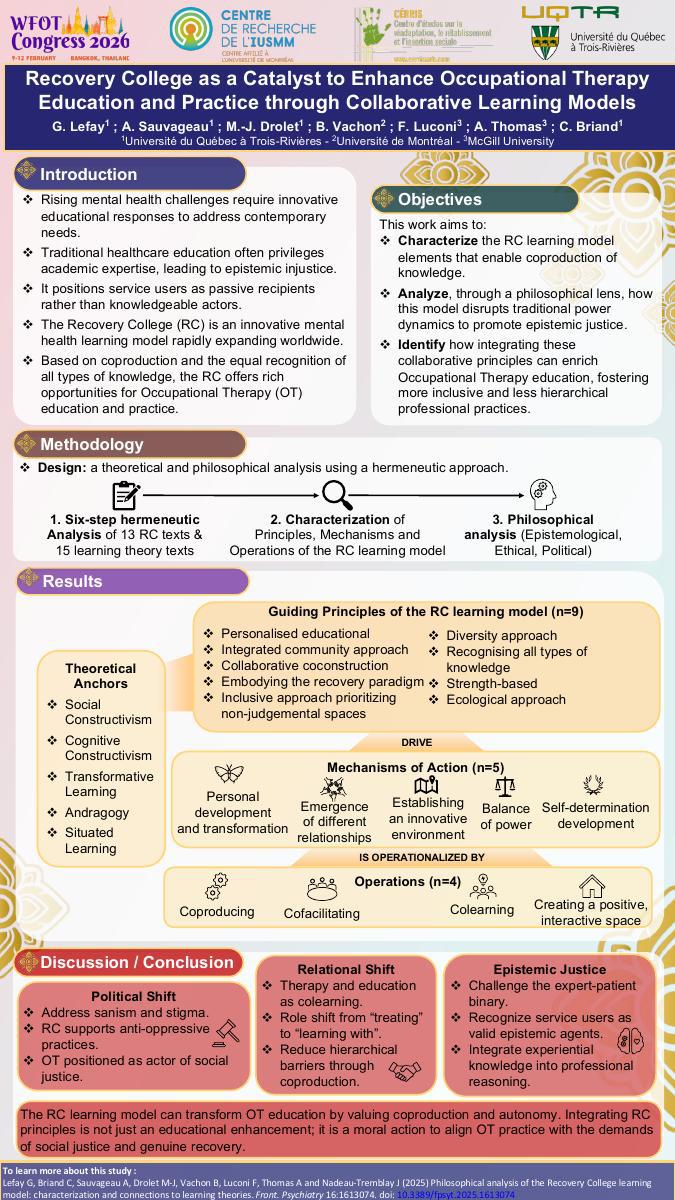
Introduction. Considering contemporary challenges in mental health, the Recovery College (RC) learning model emerges as an innovative approach that values the coproduction of knowledge, inclusion, and collaborative learning. By questioning traditional hierarchies of knowledge, this perspective offers rich opportunities for both occupational therapy education and practice
Objective. This presentation aims to explore how the RC learning model can be relevant to occupational therapists’ education and practice via the integration of its innovative principles into current educational frameworks.
Methods. Following a rigorous review of foundational texts on the RC and key learning theories (e.g., socio-constructivism, transformative learning), we conducted a six-step hermeneutic analysis of this learning model. This approach allowed us to characterize the RC model by identifying its mechanisms of action, core principles, and operations. A parallel analysis was then undertaken to draw links between the RC model and the specific requirements of occupational therapy education and practice.
Results. The analysis highlighted several key mechanisms, including personal transformation, the emergence of new collaborative relationships, and the reduction of traditional hierarchical barriers. These mechanisms foster an inclusive and personalized learning environment that promotes active engagement and the co-construction of knowledge among learners.
Conclusion/Significance for the Profession. Ultimately, the RC learning model appears to be a framework that can enrich current occupational therapy curricula. By encouraging autonomy, collaboration, and a critical reexamination of conventional paradigms, this approach could enable occupational therapists to better meet patient needs while evolving towards more inclusive professional practices.