
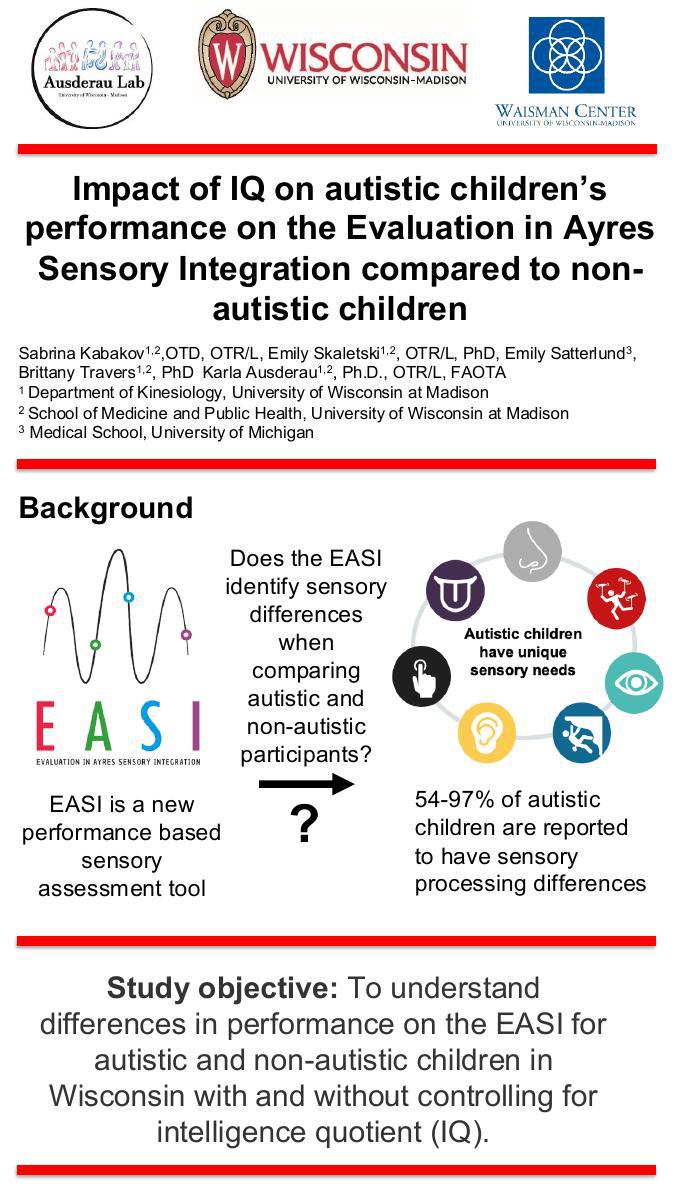
Introduction / Rationale: Autistic children often have sensory differences as compared to non-autistic children. A new assessment tool, Evaluation in Ayres Sensory Integration (EASI), is being studied to become an internationally validated and reliable tool for measuring sensory integration functions.
Objectives: This study aims to understand differences in performance on the EASI for autistic and non-autistic children in Wisconsin with and without controlling for IQ.
Methods / Approach: Autistic (n=27) and non-autistic (n=38) children between 6.0-10.0 years old were evaluated on 16 of the 20 EASI subtests in a two-hour assessment.
Results / Practice Implications: Due to testing time restraints, we had 40.7% (n=11) missing data within the younger autistic group as they had increased difficulty completing subtests within the 2-hour block. Autistic participants had significantly lower scores on praxis subtests, (visual, ideation, positions, oculomotor, sequences, following direction), visual perception, postural control, proprioception (force), and significantly higher scores for proprioception (joint position) and sensory reactivity. After controlling for IQ findings remained statistically significant for three praxis subtests (visual, oculomotor, and following directions), postural control, and sensory reactivity.
Conclusion / Contribution to the occupational therapy profession: The EASI may require additional modifications including age-related starting points to increase the success of autistic participants' completion. Additionally, the role of IQ in performance may be important to consider as only 5 of the 16 subtests remained significant after controlling for IQ. Additional research is needed to determine the most beneficial subtests for understanding sensory processing functions in autistic children to support clinic utility.