
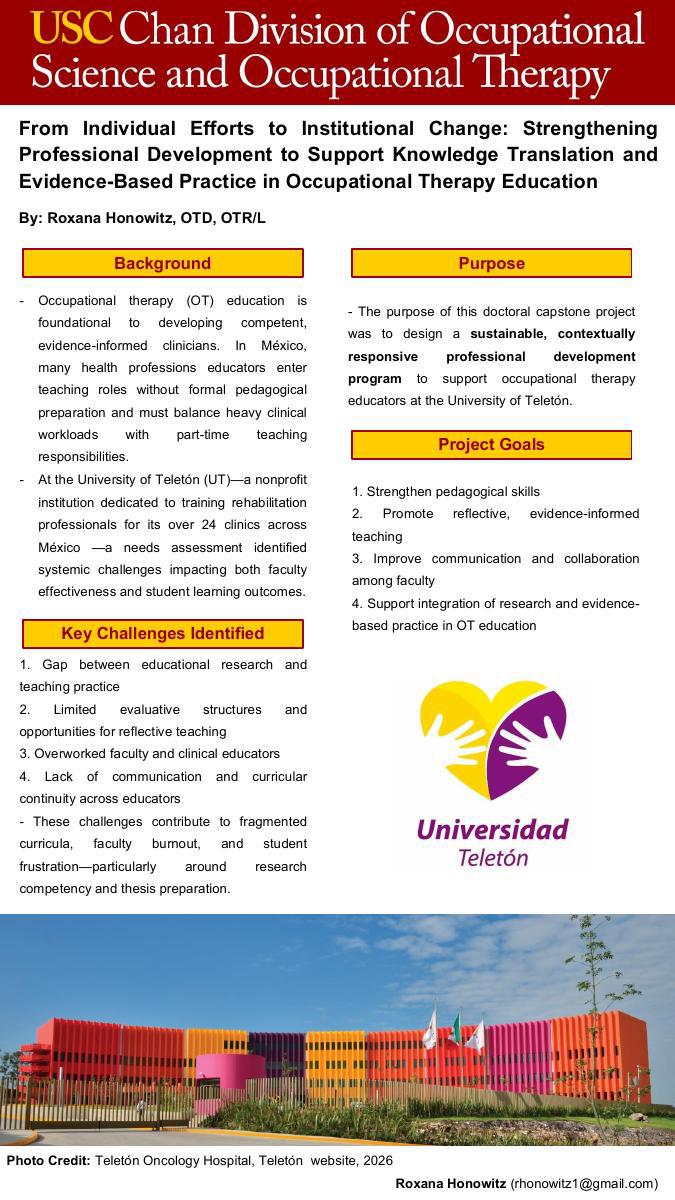
Introduction: Many occupational therapy educators in Mexico lack formal training in pedagogy, leading to a gap between best teaching practices and classroom implementation. While professional development opportunities exist, they are often underutilized due to limited awareness, access, and institutional support. Without a structured system for faculty training, professional development remains an individual responsibility rather than an institutional priority, limiting the integration of evidence-based practice (EBP) into teaching.
Objectives: This project aims to establish institutional support for professional development to enhance knowledge translation and utilization of EBP in occupational therapy education. By embedding faculty training within university structures, educators will have sustained access to pedagogical resources that facilitate the application of research findings in the classroom.
Approach: A needs assessment was conducted with faculty at the University of Teletón to identify barriers to professional development and EBP integration. Institutional perspectives were also gathered to understand administrative challenges. A framework was developed to strengthen institutional commitment through partnerships with external training providers, structured faculty development initiatives, and evaluation tools to track pedagogical growth and evidence use in teaching.
Results / Practice Implications: Findings indicate that while educators recognize the value of professional development and EBP, systemic barriers—such as lack of time, funding, and institutional prioritization—limit their implementation. By formalizing professional development within the institution, this initiative ensures that faculty have continuous access to structured training on evidence-based teaching strategies, improving classroom practices and student learning outcomes.
Conclusion / Significance to the Occupational Therapy Profession: Institutionalizing professional development supports knowledge translation, ensuring that research findings and best practices are effectively incorporated into occupational therapy education. This model provides a sustainable approach