
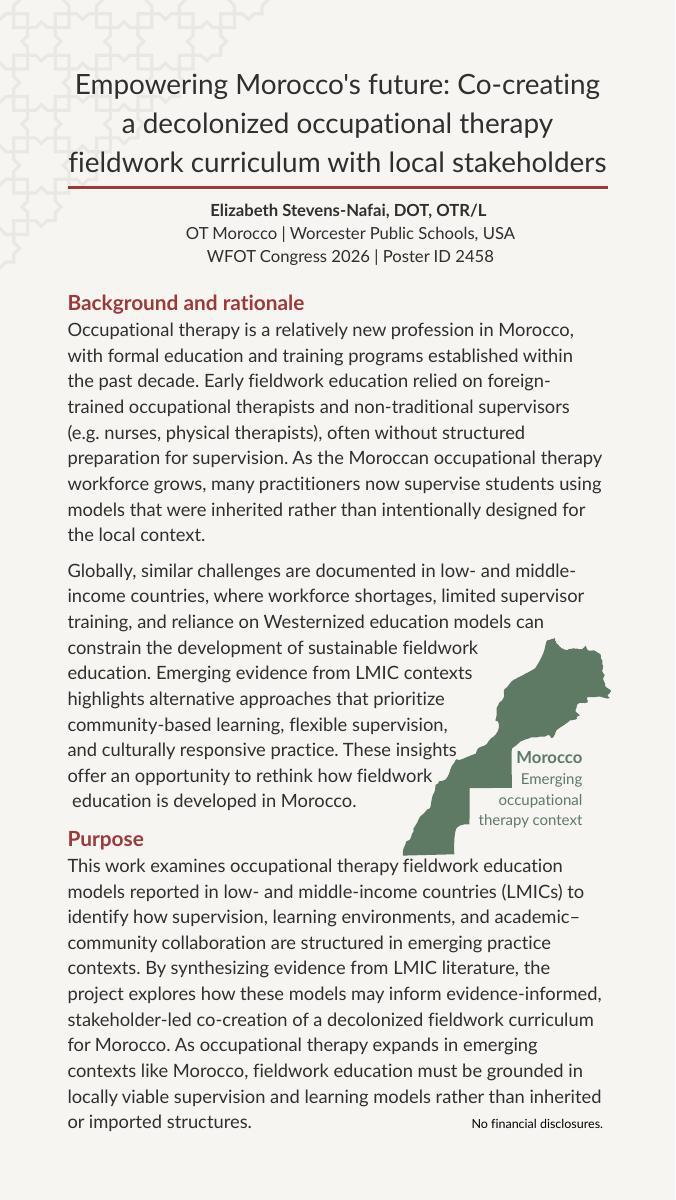
Introduction / Rationale: This project explores the development of an occupational therapy (OT) fieldwork education curriculum in Morocco. Using a systematic review and qualitative interviews with both local stakeholders and representatives from other World Federation of Occupational Therapists (WFOT) low and middle-income member (LMIC) nations. This study centers on developing a viable OT fieldwork model in Morocco, while focusing on decolonizing OT education and practice.
Objectives:
1. Develop an OT fieldwork education curriculum specific to Morocco.
2. Incorporate perspectives from local stakeholders and international WFOT LMIC nations.
3. Advance decolonizing approaches in OT education and practice.
Methods / Approach: A systematic review was conducted to identify existing frameworks for fieldwork education in LMIC nations. Semi-structured interviews were conducted with Moroccan stakeholders and international OT educators from similar contexts. Qualitative analysis was used to identify key themes for curriculum development.
Results / Practice Implications: Initial findings suggest that an OT curriculum in Morocco must prioritize culturally relevant practice, flexible supervision models, and community-based fieldwork settings. Further, decolonizing strategies such as valuing traditional healing practices and local community input emerged as critical for curriculum success.
Conclusion / Contribution to the occupational therapy profession: This work contributes to the global OT profession by offering a decolonized, context-specific model for fieldwork education in Morocco. The findings highlight the importance of culturally responsive education and can inform similar curriculum development efforts in other low and middle-income countries.