
Introduction / Rationale:
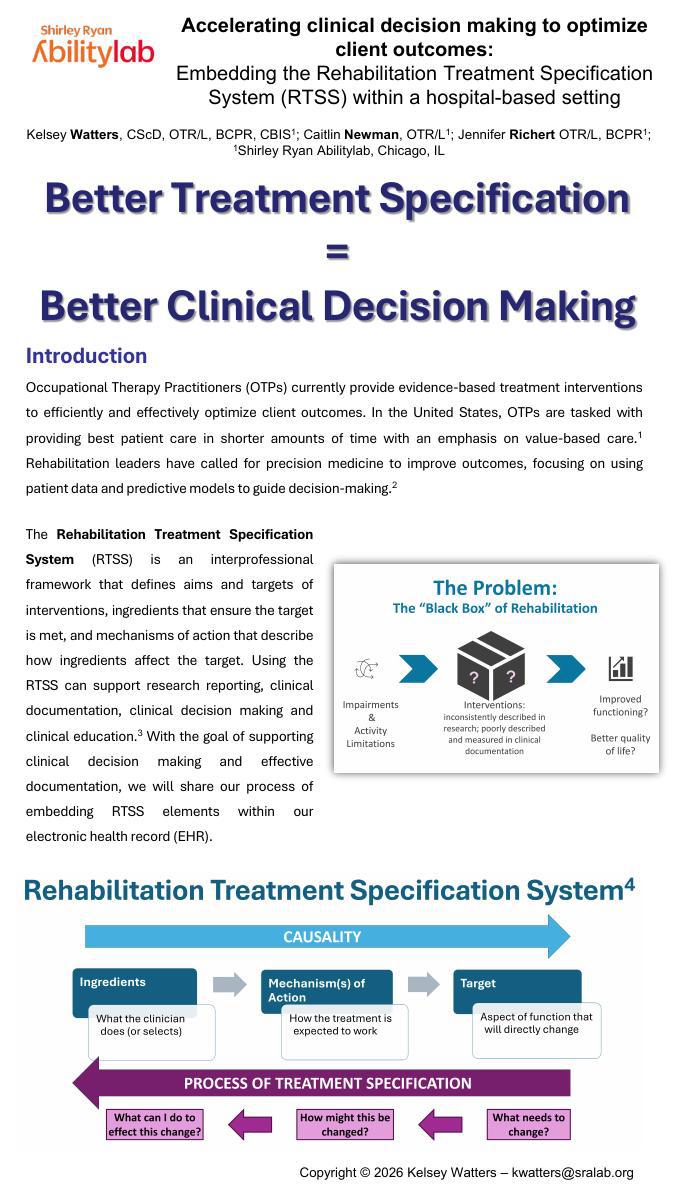
Occupational Therapy Practitioners (OTPs) provide evidence-based treatment interventions to efficiently and effectively optimize client outcomes. Despite gains in standardizing the use of outcome measures to describe functional gains, descriptions of treatment interventions can be non-specific and vague. The limited specificity of treatments provided, called the “black box of rehabilitation,” slows the advancement, development and replication of rehabilitation interventions. The Rehabilitation Treatment Specification System (RTSS) proposes an innovative way to systematically describe interventions via the aims, treatment targets, specific ingredients and mechanisms of actions by which those ingredients affect the target.
Objectives:
- Describe the general framework and components of the RTSS
- Identify benefits of using the RTSS to facilitate discussion of the clinical reasoning process
- Describe opportunities to overcome challenges of using the RTSS to support clinicians’ ability to plan and modify rehabilitation interventions
Methods / Approach:
This session will introduce the RTSS, including the theoretical basis, definitions of components, practical application in clinical and academic settings and potential for future innovations. Case examples will demonstrate how OTPs can critically reflect on their rationale for selecting treatments and effectively describe interventions provided.
Results / Practice Implications:
Using the systematic method proposed by the RTSS to support complex clinical decision making, this session will describe an implementation program that was designed to facilitate the integration of RTSS principles within a clinical setting.
Conclusion / Contribution to the occupational therapy profession:
The RTSS encourages OTPs to critically appraise available treatment interventions to thoughtfully select and describe the complex treatment interventions they provide to optimize client outcomes.