
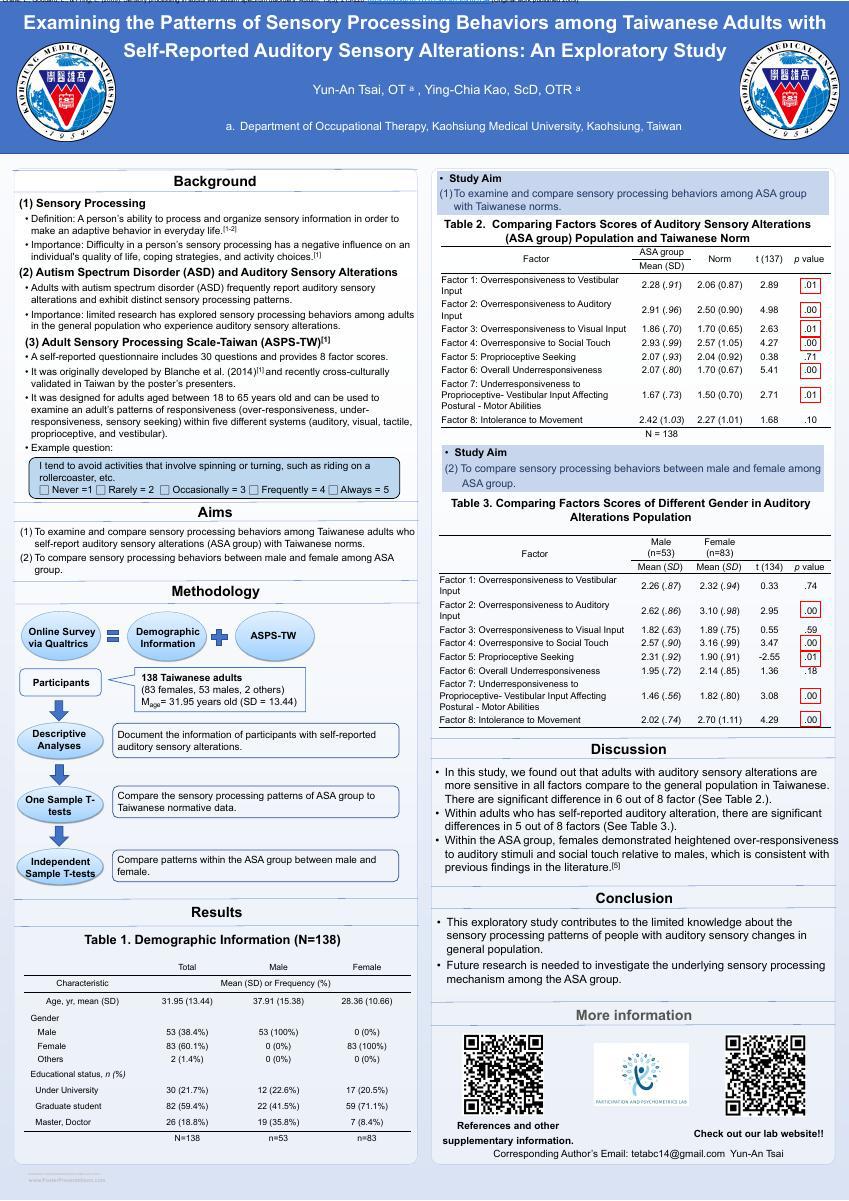
Background: Previous research has shown that adults with autism spectrum disorder (ASD) frequently report auditory sensory alterations and exhibit distinct sensory processing patterns. However, limited research has explored sensory processing behaviors among adults in the general population who experience auditory sensory alterations, particularly in Taiwan.
Objectives: This exploratory study aims to (1) examine sensory processing behaviors among Taiwanese adults who self-report auditory sensory alterations and (2) compare their sensory processing patterns to established Taiwanese norms.
Methods: This cross-sectional study collected self-reported data from Taiwanese adults aged 18–65 via an online survey, which included demographic information, questions related to sensory alterations and psychiatric diagnoses, and the Adult Sensory Processing Scale–Taiwan (ASPS-TW). The ASPS-TW assesses sensory processing patterns across five distinct sensory systems and includes eight subscale scores. Descriptive statistics and one-sample t-tests were used to compare the sensory processing patterns of adults with auditory sensory alterations to Taiwanese normative data.
Results: A total of 138 adults (Mage = 31.95, SD = 13.44; 83 females, 53 males, and 2 other) without a psychiatric diagnosis who self-reported auditory sensory alterations participated in this study. Compared to Taiwanese norms, adults with auditory sensory alterations exhibited significantly higher scores on six subscales (over-responsiveness to vestibular inputs, over-responsiveness to auditory inputs, over-responsiveness to visual inputs, over-responsiveness to social touch, overall under-responsiveness, and under-responsiveness to proprioceptive-vestibular inputs).
Conclusions: These findings suggest that adults with auditory sensory alterations demonstrate distinct sensory processing patterns. Further research is needed to explore the underlying mechanisms.