
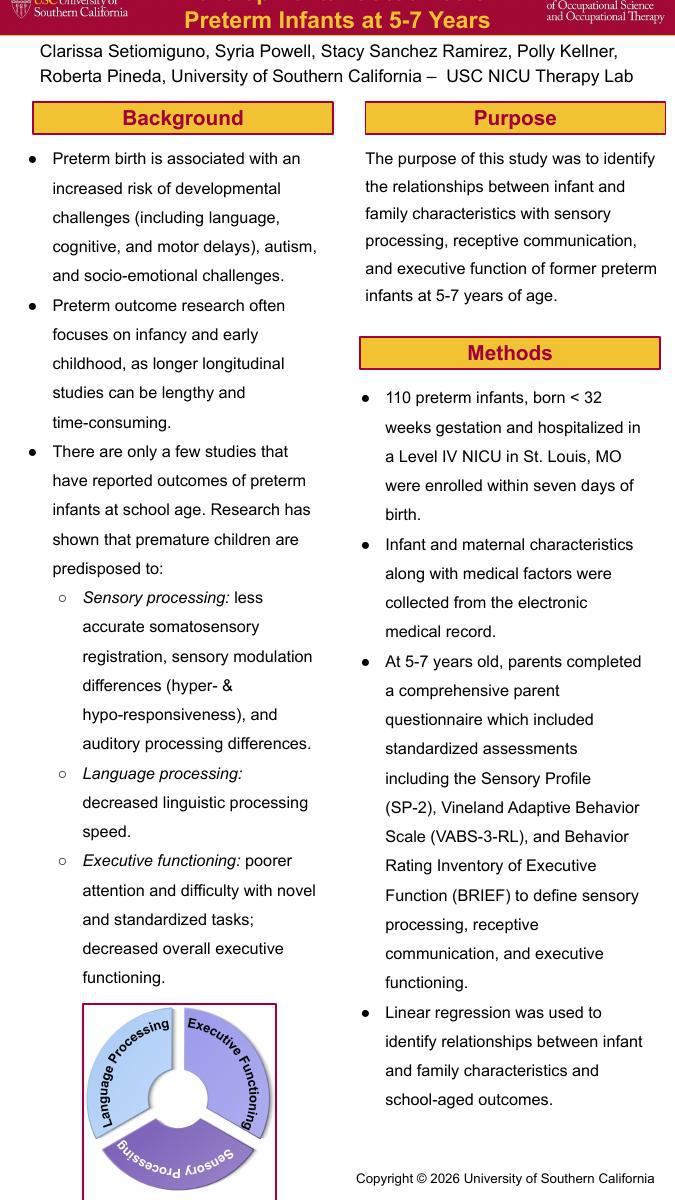
Introduction / Rationale: Established research links preterm birth to developmental challenges in early childhood. However, the correlation into school-age is limited.
Objectives: This study aims to identify the impact of infant and family characteristics on the developmental outcomes of former preterm infants at 5-7 years related to executive function, sensory processing, and receptive
communication.
Methods / Approach: Preterm infants, born < 32 weeks gestation and hospitalized in a Level IV NICU in St. Louis, were enrolled within seven days of birth. Upon completion of NICU stay, infant and maternal characteristics were documented. At 5-7 years, comprehensive parent questionnaires were completed including the VABS-3-RL, BRIEF, and SP-2. Linear regression was used to identify relationships between infant and family characteristics and school-aged outcomes.
Results / Practice Implications: Significant relationships were found between infant sex and under-responsivity/sensory-seeking (p=0.01, ß=3.81); race and movement (p=0.01, ß=1.51); maternal age and movement (p=0.02, ß=0.12); marital status and taste/smell (p=0.03, ß=3.12); length of hospital stay (LOS) and vision (p=0.03, ß=0.03); LOS and low energy/weakness scores (p=<0.001; ß=-0.05); and Necrotizing Enterocolitis (NEC) diagnosis and taste/smell (p=0.03; ß =-3.60).
Conclusion / Contribution to the occupational therapy profession: While characteristics of infants and mothers at the end of NICU stay correlated to some developmental outcomes in school age, the causal link is still unclear. Thus, further research in early development of preterm infants through age 5-7 is recommended.
Funding Support: This work was supported by the Center for the Changing Family