
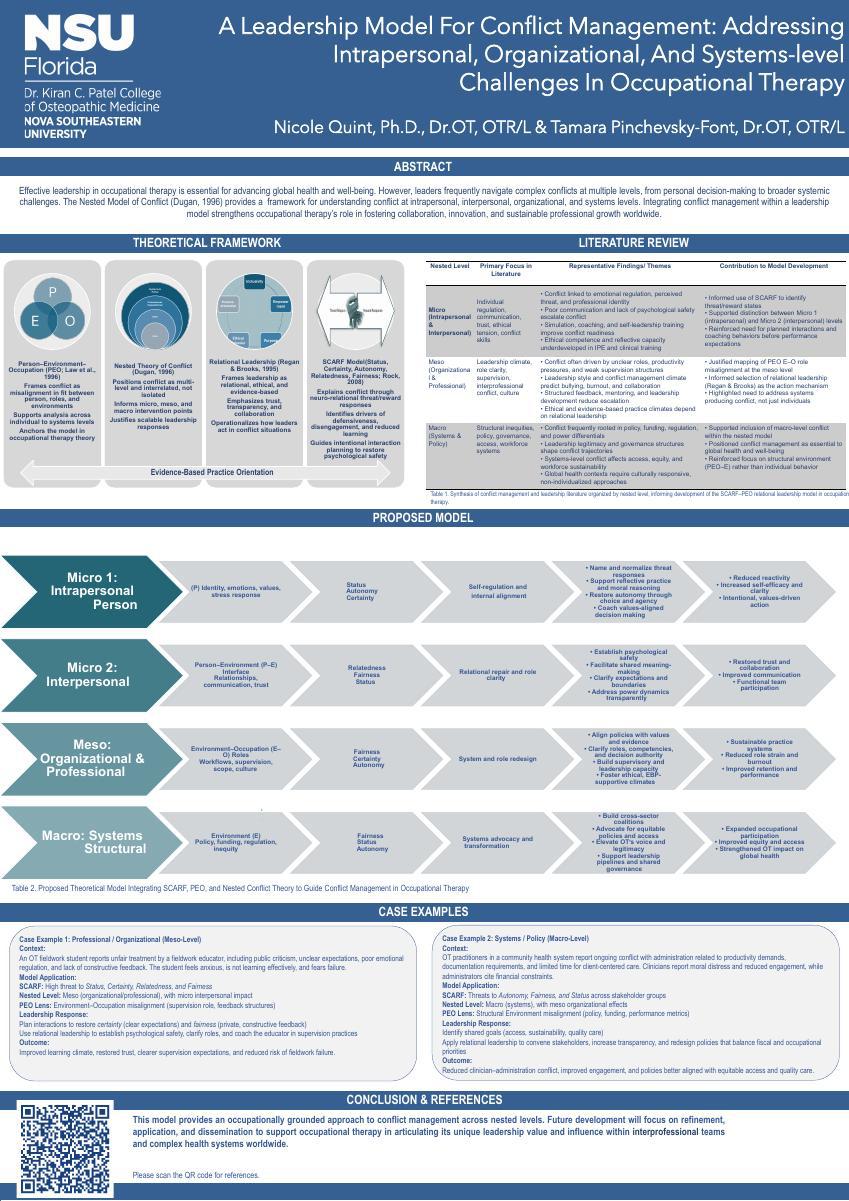
Effective leadership in occupational therapy is essential for advancing global health and well-being. However, leaders frequently navigate complex conflicts at multiple levels, from personal decision-making to broader systemic challenges. The Nested Model of Conflict (Dugan, 1996) provides a framework for understanding conflict at intrapersonal, interpersonal, organizational, and systems levels. Integrating conflict management within a leadership model strengthens occupational therapy’s role in fostering collaboration, innovation, and sustainable professional growth worldwide.
Methods / Approach:The leadership model integrates Mayer’s conflict model, which emphasizes cognitive, emotional, and behavioral dimensions of conflict, alongside evidence-based negotiation strategies and occupational therapy’s unique approach to person-centered and systems-level interventions. Case examples from diverse practice settings illustrate how conflict management strengthens leadership effectiveness and service delivery.
Results / Practice Implications:
Applying this leadership model enhances workplace collaboration, reduces burnout, and promotes ethical decision-making. At an organizational and systems level, the model fosters resilience, advocacy, and interprofessional cooperation, ultimately improving occupational therapy’s impact in diverse global contexts.
Conclusion / Contribution to the Profession:
By embedding conflict management within occupational therapy leadership, this model supports the profession’s sustainability and effectiveness. It provides a structured approach for practitioners to navigate challenges, drive change, and contribute to global health initiatives in alignment with WFOT’s mission.