
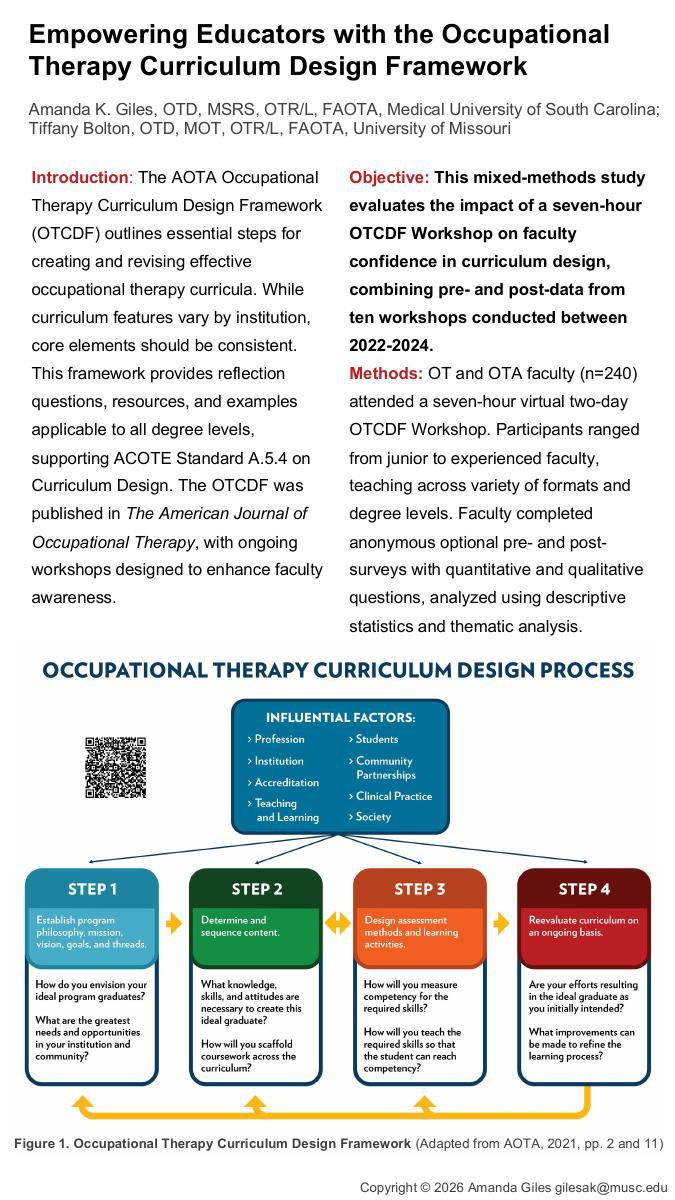
Introduction: The AOTA Occupational Therapy Curriculum Design Framework (OTCDF) outlines essential steps for creating and revising effective occupational therapy curricula. While curriculum features vary by institution, core elements should be consistent. This framework provides reflection questions, resources, and examples applicable to all degree levels, supporting ACOTE Standard A.5.4 on Curriculum Design. The OTCDF was published in the American Journal of Occupational Therapy by the authors of this abstract, with ongoing workshops designed to enhance faculty awareness.
Objective: This mixed-methods study evaluates the impact of a seven-hour OTCDF Workshop on faculty confidence in curriculum design, combining pre- and post-data from ten workshops conducted between 2022-2024.
Methods: Occupational therapy (OT) and occupational therapy assistant (OTA) faculty (n=240) attended a seven-hour virtual two-day OTCDF Workshop. Participants ranged from junior to experienced faculty, teaching across variety of formats and degree levels. Faculty completed anonymous optional pre- and post-surveys with quantitative and qualitative questions, analyzed using descriptive statistics and thematic analysis.
Results: Faculty confidence significantly improved after the workshop. Pre-workshop confidence levels were low in curriculum design knowledge (33%), backwards design (31%), educational theories (48%), and curriculum evaluation (30%). Post-workshop confidence increased in all areas (95%, 91%, 91%, 84%, respectively). Most faculty (n=97%) reported that they gained ideas that they will apply to their curriculum. Themes highlighted the value of user-friendly resources, clear explanations, and networking opportunities.
Contribution: The OTCDF workshops promote teaching excellence, innovation, and consistency in OT/OTA education. As new generations of faculty emerge, structured curriculum design approaches are critical for advancing the profession.