
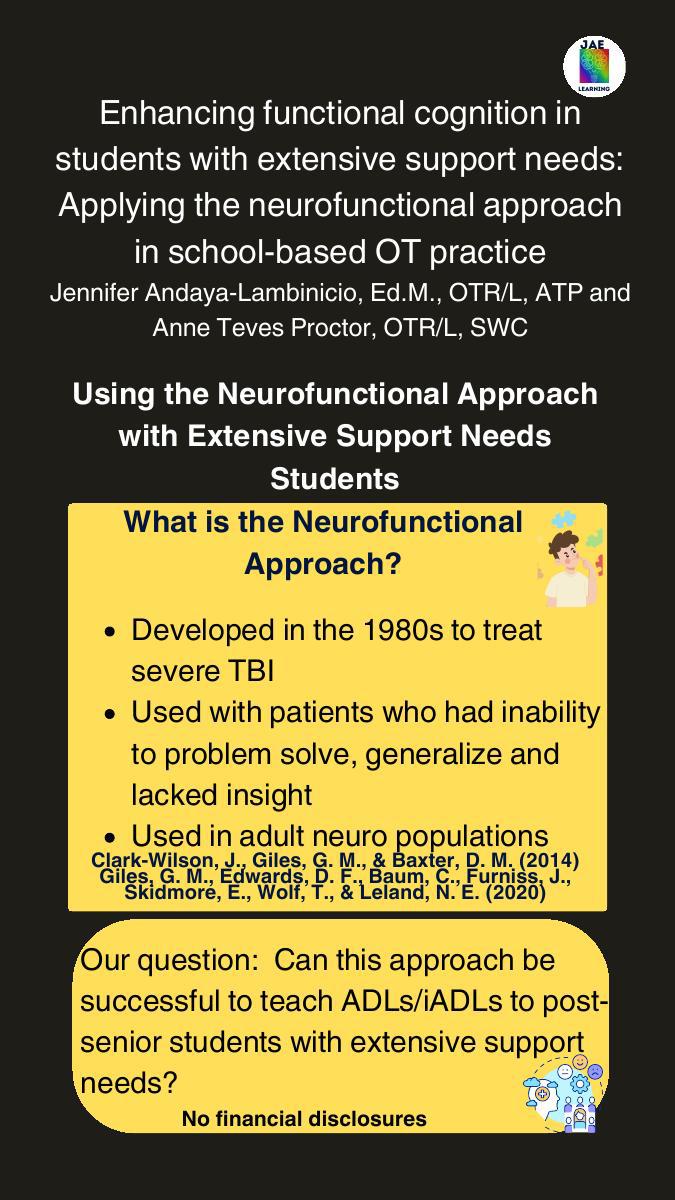
Introduction / Rationale:Functional cognition in students with extensive support needs (ESN) and in school-based practice has not been explored. Its application to the pediatric population is limited to critically ill children. This approach includes the Neurofunctional Approach with an 8-step process for assessment and intervention that school-based OTs can use with students with ESN. The use of this evidence-based approach has been identified as appropriate for individuals who have difficulty integrating thinking and performance skills to accomplish complex everyday activities through skill habit training.
Objectives:
1. To describe the cognitive skills of students with extensive support needs (ESN) related to their performance of school-relevant ADLs and simple IADLs
2. To explore the application of the Neurofunctional Approach to functional cognition in school-based practice with students with ESN
Methods / Approach: The 8 steps of the Neurofunctional Approach were used in teaching pre-vocational and IADL tasks to 2 individual cases and 1 group of students in 2 post-secondary special education classes. A consistent set of visuals of task-analyzed skills and prompting was ensured throughout all treatment sessions to teach the target skills.
Results / Practice Implications: There was an increase in the level of independence in prevocational and IADL tasks and the number of tasks performed independently in individual and group cases. The students benefitted from the consistent use of visuals and the same set of prompts every treatment session for teaching the target skills.
Conclusion / Contribution to the occupational therapy profession: The Neurofunctional Approach is adaptable for students with extensive support needs. Repetition and practice in natural contexts facilitate independence in performing school-relevant ADLs and IADLs, including prevocational skills.