
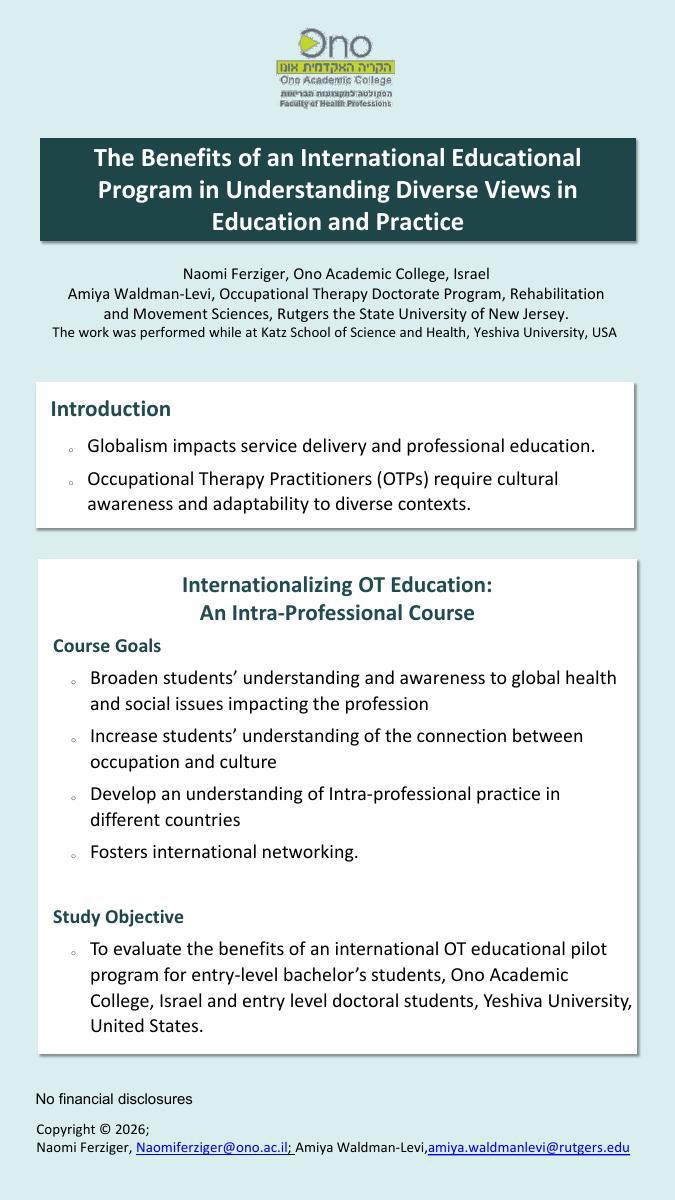
Introduction: Globalization necessitates cultural competence among occupational therapy practitioners (OTPs), requiring them to understand the influence of societal, political, and economic contexts on practice. Internationalizing OT education broadens students' perspectives on global health, social issues, occupation, and culture, while exposing them to diverse service delivery models. This can lead to expanded OT services for marginalized populations, foster international networking, and enhance collaboration (Horton, 2009).
Objectives: To evaluate the benefits of an international OT educational pilot program for entry-level bachelor's and doctoral students.
Approach: The pilot program utilized Transformative Learning Theory principles, incorporating experiential learning, empathy, and expanding students' views of the profession. The program included two remote sessions (one focused on OT education, the other on OT practice) with a mixed group of students from two countries and diverse backgrounds. Each session comprised an introduction, student presentations in breakout rooms, and a debriefing session. A post-program survey was administered via Qualtrics.
Results: Twenty-seven students participated (48.1% bachelor's, 51.9% doctoral). High satisfaction was reported (M = 8.52; SD = 1.95). Students gained valuable insights into international OT education and practice, the value of international perspectives, and the influence of culture on service delivery.
Contribution to the occupational therapy profession: Integrating international perspectives into OT education fosters collaboration, cultural awareness, and a deeper understanding of the profession's global reach. This prepares OTPs to effectively treat diverse populations and broaden their understanding of occupation within global contexts.