
Introduction
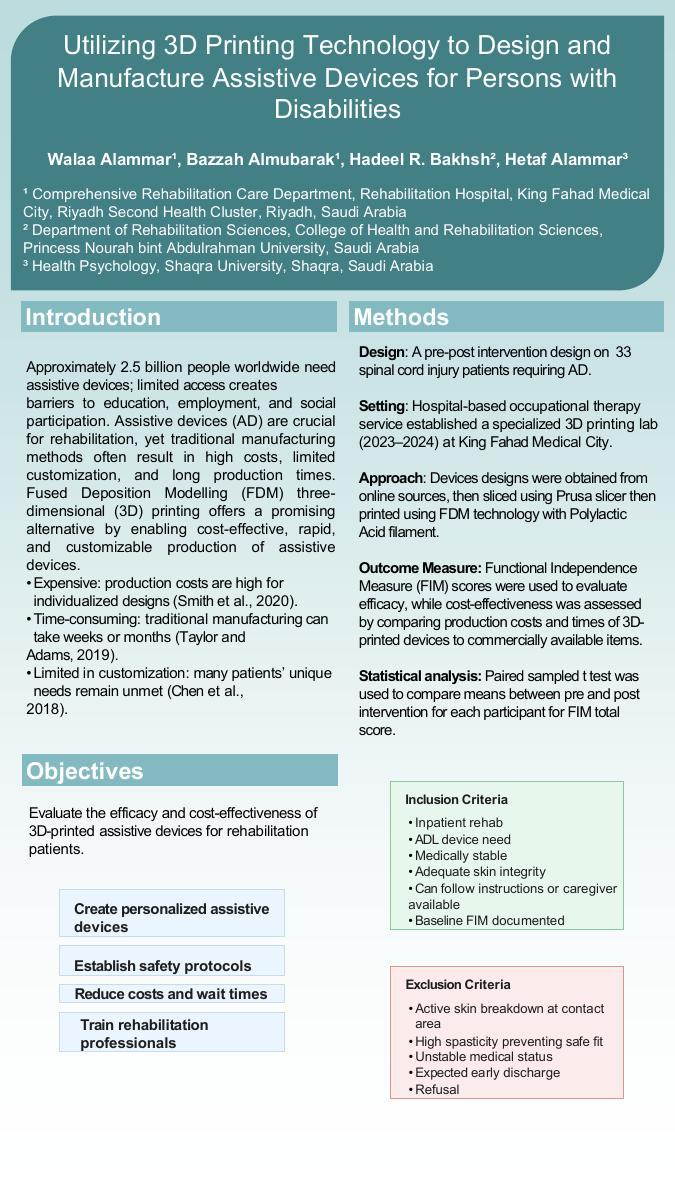
Assistive devices (AD) are crucial for rehabilitation, yet traditional manufacturing methods often result in high costs, limited customization, and long production times. Fused Deposition Modeling (FDM) three dimensional (3D) printing offers a promising alternative by enabling cost-effective, rapid, and customizable production of assistive devices.
Objectives
1-To assess the functional improvements and cost-effectiveness of 3D-printed AD compared to traditional methods.
2-To determine whether 3D printing could provide a viable solution for producing personalized, affordable, and timely AD for spinal cord injury patients.
Methods
A pre-post intervention design on 33 spinal cord injury patients requiring AD. Devices designs were obtained from online sources, then sliced using Prusa slicer then printed using FDM technology with Polylactic Acid filament. Functional Independence Measure (FIM) scores were used to evaluate efficacy, while cost-effectiveness was assessed by comparing production costs and times of 3D-printed devices to commercially available items. Paired sampled t test was used to compare means between pre and post intervention for each participant for FIM total score.
Results
The study found statistically significant improvements in FIM scores post-intervention (p = 0.001), indicating enhanced functional independence. Cost-effectiveness analysis revealed that 3D-printed devices were 6 to 287 times more economical than commercial equivalents, with significant reductions in production time. 3D printing eliminated shipping delays and improved accessibility, particularly in regions like Saudi Arabia where some commercial items are unavailable.
Conclusion
This study highlights the economic and functional benefits of 3D-printed AD, emphasizing their potential to enhance patient-cantered care. By enabling rapid prototyping, customization, and local production, 3D printing can bridge the gap between affordability and acceibility of OT, offering sustaibable and affordable solution for rehabilitation settings