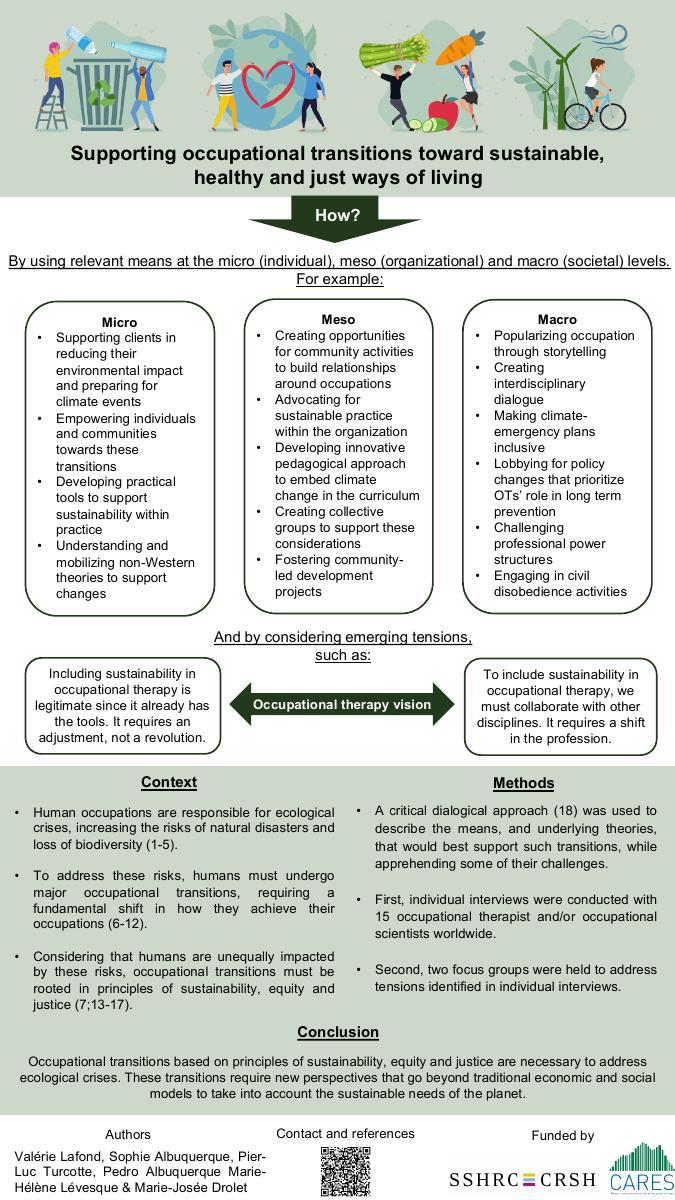
Introduction: Globally, human occupations are responsible for the production of ecological crises, increasing the risks of natural disasters and biodiversity loss. To mitigate and adapt to these risks, humans are undergoing major occupational transitions that require a deep transformation of how they achieve their occupations. Considering that humans are unequally impacted by these risks, occupational transitions must be rooted in principles of sustainability, equity and justice. However, the literature on means and theories to undertake such transitions remains limited.
Objectives: The study seeks to understand the perspective of occupational therapy scientists involved in supporting occupational transitions in a context of ecological crisis. In doing so, our aim is to describe the means, and underlying theories, that would best support such transitions, while apprehending some of their challenges.
Methods: This ongoing qualitative study, rooted in a critical dialogical approach, aims to interview in three different languages over 20 occupational therapy scientists worldwide involved in supporting occupational transitions with individuals or communities facing the impacts of the ecological crises. Content from interview transcripts is co-analyzed using a dialogical approach between researchers and participants.
Results: Preliminary findings indicate that participants support occupational transitions through empowering individuals and communities. Moreover, participants acknowledge the importance of non-Western theories to the operationalization of means.
Conclusion: Occupational transitions, rooted in principles of sustainability, equity and justice, are required to mitigate and adapt to the risks of the ecological crises. These transitions must entail different perspectives from traditional socio-economic models to consider the world’s ecological needs sustainably.
