
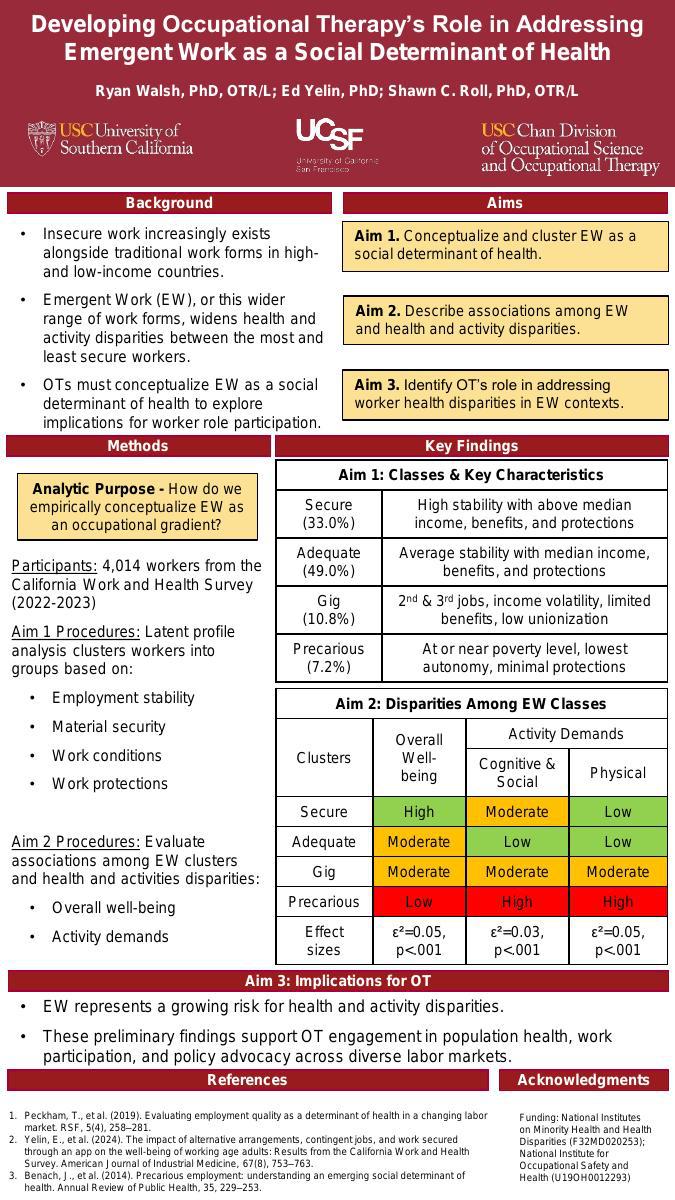
Introduction / Rationale: Emergent work (EW) – or work that is non-standard, precarious, gig, or app-based – has become a prevalent labor arrangement. In addition to lower financial well-being, EW is associated with poorer health behaviors, such as eating and physical activity habits and stress management. Occupational therapy’s (OT’s) role in addressing EW as a social determinant of health (i.e., the conditions in which people are born, work, live, and age) is under-developed.
Objectives: Describe EW as a social determinant of health and identify OT’s role in addressing worker health disparities in EW contexts.
Methods / Approach: We will review scholarship that classifies forms of EW across differing global contexts. Then, we will highlight evidence for health disparities and opportunities for OT researchers and practitioners to address them in EW contexts. The presentation will leverage our ongoing preliminary work funded by the National Institutes of Health to understand EW as a social determinant of health in the California labor force as well as sectors of the North American healthcare labor force.
Results / Practice Implications: OT researchers and practitioners offer a unique focus on optimizing health and well-being in worker role participation. Expanding evidence for OT’s role beyond traditional worker health areas (e.g., return-to-work, work hardening, and ergonomics) and into addressing EW as a social determinant of health aligns with the World Health Organization’s strategic priorities to expand access to quality and reliable occupational health services to underserved workers in novel community settings.
Conclusion / Contribution to the occupational therapy profession: OT must play a role in developing evidence and practice to serve the evolving health needs of contemporary workers.