
Introduction
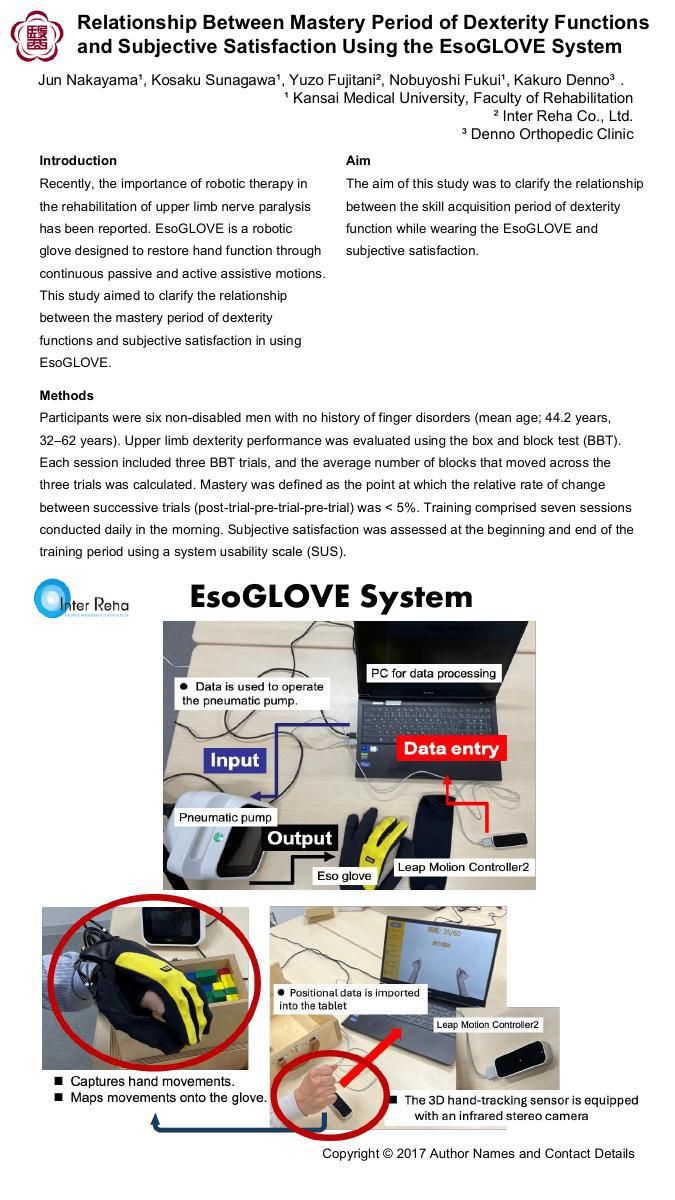
Recently, the importance of robotic therapy in the rehabilitation of upper limb nerve paralysis has been reported. EsoGLOVE is a robotic glove designed to restore hand function through continuous passive and active assistive motions. This study aimed to clarify the relationship between the mastery period of dexterity functions and subjective satisfaction in using EsoGLOVE.
Methods
Participants were six non-disabled men with no history of finger disorders (mean age; 44.2 years, 32–62 years). Upper limb dexterity performance was evaluated using the box and block test (BBT). Each session included three BBT trials, and the average number of blocks that moved across the three trials was calculated. Mastery was defined as the point at which the relative rate of change between successive trials (post-trial-pre-trial-pre-trial) was < 5%. Training comprised seven sessions conducted daily in the morning. Subjective satisfaction was assessed at the beginning and end of the training period using a system usability scale (SUS).
Results
The mean number of blocks moved in the BBT stabilized at the fourth session, with an average of 18.0 ± 0.91 blocks, showing a -3.2% change rate from the third session (18.6 ± 1.04 blocks). SUS scores significantly improved from 65.8 ± 3.8/100 at the start to 81.9 ± 10.8/100 at the end of training.
Discussion: Recently, EsoGLOVE has been reported to be effective in neurorehabilitation. Mastery of upper limb operability was associated with increased patient satisfaction, indicating the potential of improved upper limb function to enhance overall satisfaction.