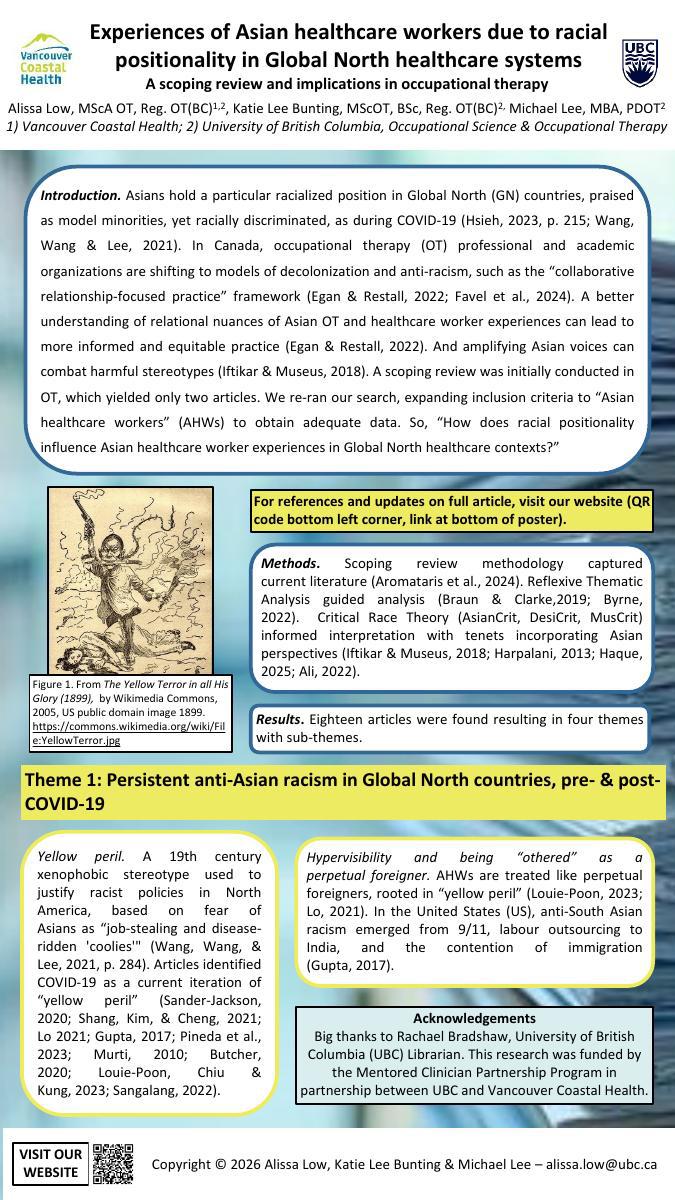
Introduction. In Global North healthcare settings, Asian healthcare workers are experiencing a contemporary evolution of systemically imposed social positioning, triangulated between oppression of Indigenous and Black peers versus privileging of white peers. These dynamics are reflected in occupational therapy, and lack of Asian occupational therapist-focused literature perpetuates silencing and erasure of Asian voices. Objectives. Identify literature on Asian healthcare workers’ experiences due to racial positionality in Global North healthcare settings. Methods. A scoping review was conducted to capture existing literature. “Healthcare worker” was chosen instead of “occupational therapist” with the lack of literature in occupational therapy. Critical Race Theory was used as a guiding theory to critique systemic structures that shape experiences of Asian healthcare workers. Results. Four themes (with sub-themes) emerged: 1) Persistent Asian racism in Global North countries, pre- and post-COVID-19 (yellow peril; model minority; invisibility and microaggressions; burdens and emotional labour of racialization; hypervisibility and being “othered” as a perpetual foreigner; the rise in Asian racism post-COVID-19; COVID-19 Asian healthcare worker inequities); 2) Nuanced interpersonal dynamics for Asian healthcare workers (immigration and acculturation, transference and countertransference; clinician-patient concordance); 3) Systemic Asian discrimination in healthcare (limitations in career advancement and inequitable work conditions, the Filipino migrant experience); 4) Solidarity (call to action). Conclusion. Identifying research on Asian healthcare worker positionality and applying critical perspectives can resist imposed social positions on Asian healthcare workers, including occupational therapists, and guide critical actions towards systems change, such as speaking up in solidarity with other equity-deserving groups or cultivating culturally safer environments.
