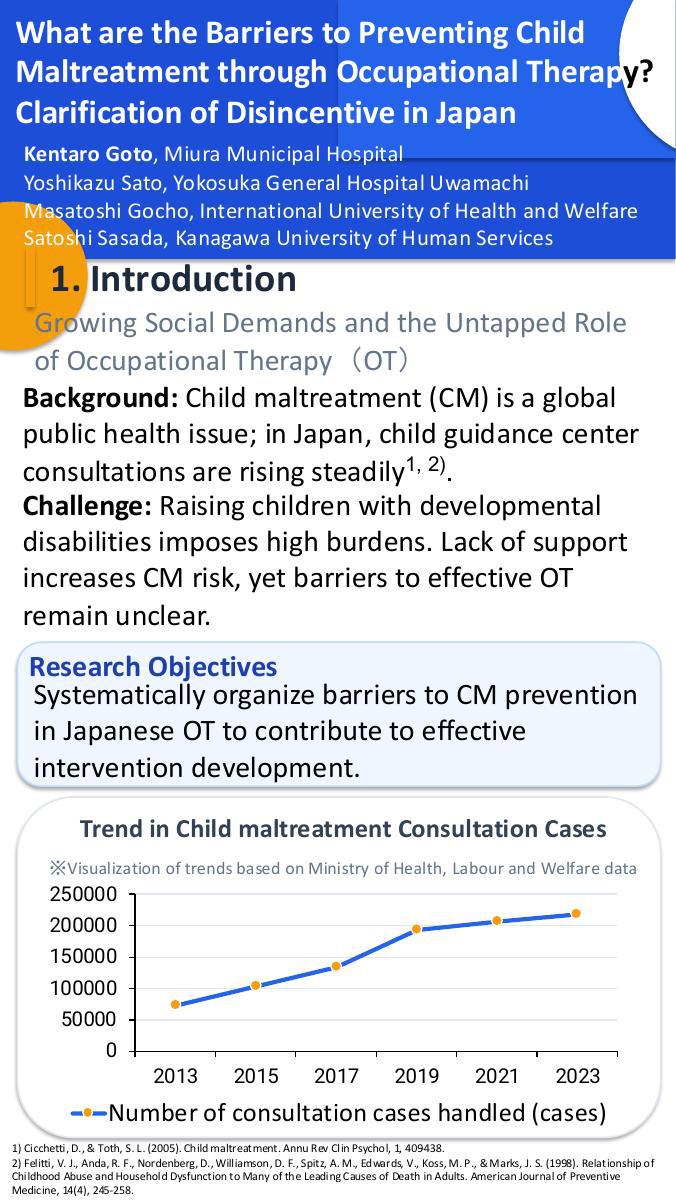
Introduction: Child abuse is a growing public health concern globally (Felitti et al., 1998) and in Japan. Reports indicate rising cases linked to family structure changes, social isolation, and parenting stress (MHLW, 2023). Multiple factors contribute to child abuse, including individual, familial, social, and institutional elements (Cicchetti & Toth, 2005). Parents of children with developmental disabilities experience higher stress, increasing maltreatment risk if support is inadequate (Rodriguez & Murphy, 1997; Takayama, 2022). Despite the need for multidisciplinary collaboration (Ishii et al., 2020), research on barriers faced by occupational therapists is limited. Occupational therapy can reduce stress, modify home environments, and support interprofessional collaboration (Goto et al., 2023), but these challenges require systematic analysis to guide effective interventions.
Objectives: This study identifies barriers to occupational therapy involvement in child abuse prevention in Japan.
Methods: Semi-structured online interviews were conducted with four occupational therapists. Data were transcribed verbatim and analyzed using reflective thematic analysis (Braun & Clarke, 2019).
Results: Six themes were developed: limited understanding of child development, psychological resistance to support, maladaptive parenting and stress cycles, weak multidisciplinary collaboration, inadequate community networks, and institutional constraints.
Conclusion: Barriers were categorized using Bronfenbrenner’s Ecological Systems Theory: micro (parental stress and knowledge gaps), meso (care continuity and collaboration), exo (regional disparities), and macro (policy and cultural norms). These barriers delay intervention, disrupt service continuity, and reduce access to coordinated support. Occupational therapists can mitigate these challenges through parent education, interprofessional collaboration, and policy advocacy, thereby contributing to improved service accessibility and continuity. Strengthening their professional role in prevention efforts may enhance the effectiveness of intervention strategies and support the development of more integrated services within existing policy frameworks.