
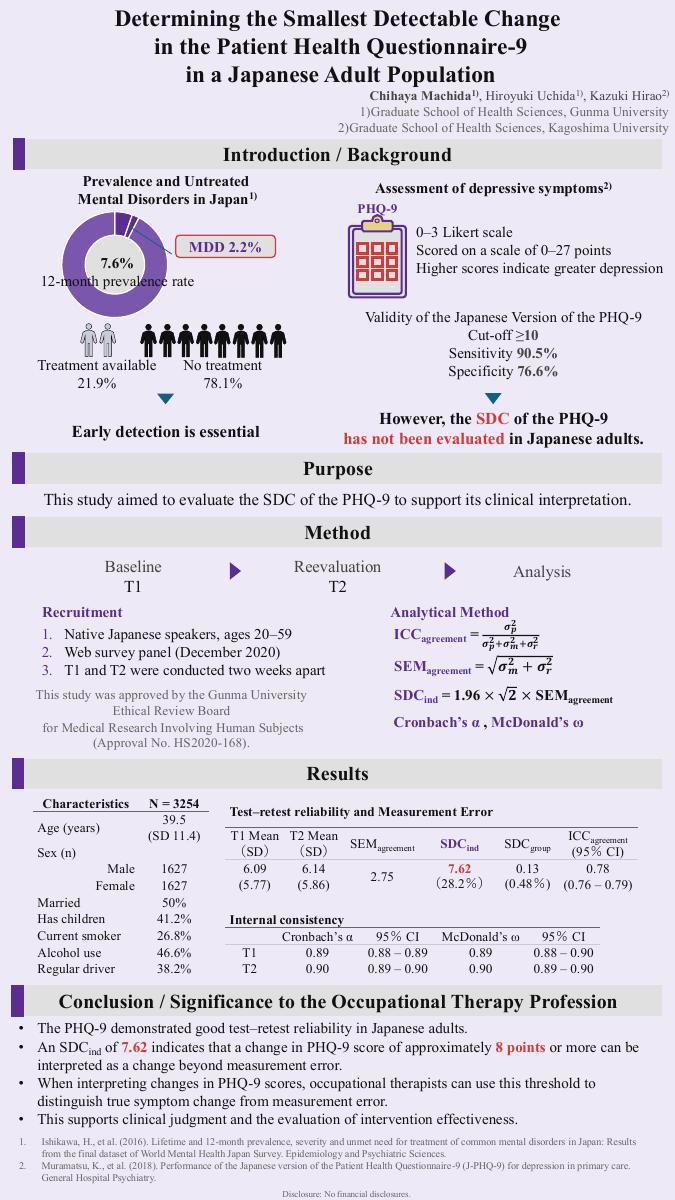
Introduction / Rationale: Depression is prevalent, and early detection is essential. The Patient Health Questionnaire-9 (PHQ-9) is a widely used, nine-item patient-reported outcome measure for assessing depressive symptoms. However, its smallest detectable change (SDC) has not been evaluated in Japanese adults.
Objectives: This study aimed to evaluate the SDC of the PHQ-9 to support its clinical interpretation.
Methods / Approach: Native Japanese-speaking adults aged 20–59 were recruited from a web survey panel and completed the PHQ-9 at baseline (T1) and two weeks later (T2). SDC was computed at the individual (SDCind) and group (SDCgroup) levels. Test–retest reliability was assessed using ICCagreement from a two-way random-effects model, and internal consistency was evaluated with Cronbach’s alpha and McDonald’s omega. The study was approved by the Ethical Review Board.
Results / Practice Implications: A total of 3254 participants (1627 males, 1627 females) completed both T1 and T2. The mean (SD) PHQ-9 scores were 6.09 (5.77) at T1 and 6.14 (5.86) at T2. The individual-level SDC (SDCind) was 7.62, and the group-level SDC (SDCgroup) was 0.13. The ICCagreement was 0.78 (95% CI: 0.76–0.79). Cronbach’s alpha was 0.89 (95% CI: 0.88–0.89) at T1 and 0.90 (95% CI: 0.89–0.90) at T2, and McDonald’s omega was 0.89 (95% CI: 0.88–0.90) at T1 and 0.90 (95% CI: 0.89–0.90) at T2.
Conclusion / Significance to the Occupational Therapy Profession: The PHQ-9 showed robust reliability, and its SDC provides occupational therapists with a metric to distinguish true symptom changes from measurement error, supporting clinical decision-making.