
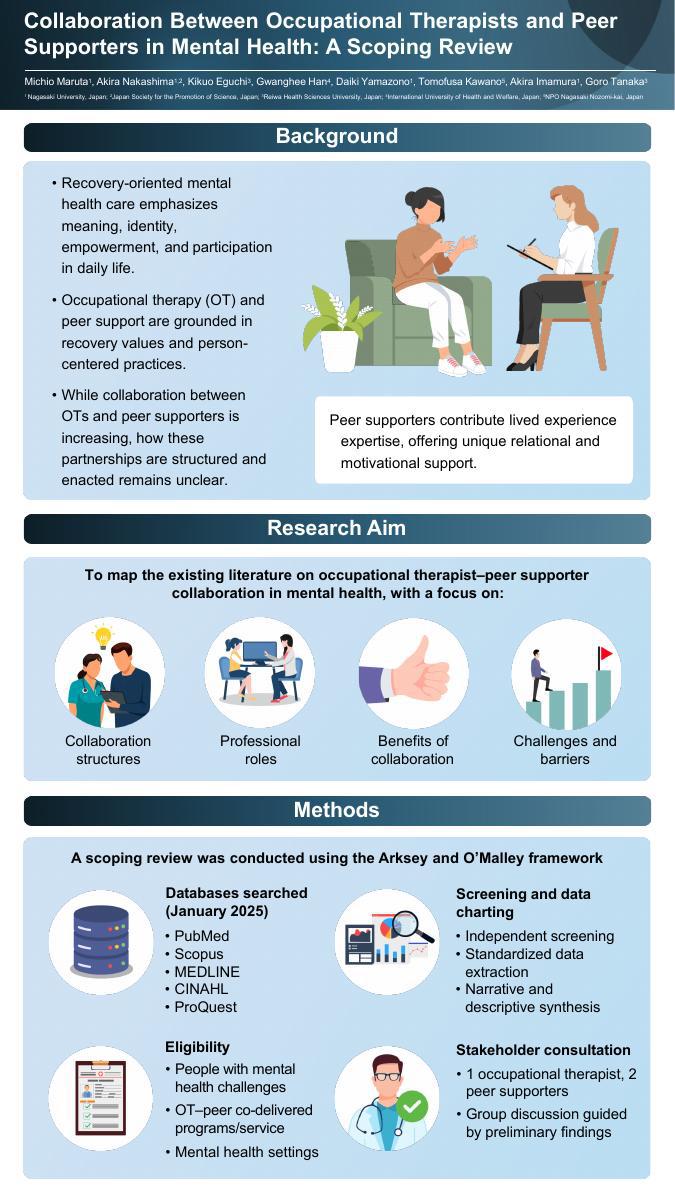
Introduction: Peer support plays a crucial role in mental health services, with peer supporters (PSs) drawing on their own experiences to facilitate the recovery. Integrating the expertise of occupational therapists (OTs) into the collaboration with PSs may further enhance client recovery. However, potential collaborations and benefits remain underexplored.
Objectives: This study maps previous literature on OT–PS collaboration in mental health, identifying key models, roles, and reported outcomes.
Methods: Following Arksey and O’Malley’s framework (2005), the following databases were systematically searched: PubMed, Scopus, MEDLINE, CINAHL, and ProQuest. Studies were included if OTs and PSs collaborated in mental health intervention programs. Data extraction focused on collaboration models, roles, and outcomes.
Results: Of the 112 studies identified, 17 met the inclusion criteria, encompassing eight programs. These initiatives employed the following collaborative models: (1) peer-led models, where PSs led programs with OT contributing research, evaluation, training, and supervision; (2) OT-led models, where OTs designed and facilitated programs while incorporating PSs for peer-based support; and (3) co-facilitated models, where OTs and PSs collaboratively planned and implemented programs. OTs contributed professional expertise while PSs drew on lived experiences, creating a complementary collaboration. Client outcomes included improved social participation, skill development, and meaningful activity engagement, among other things. Although collaboration was well received, role boundaries and power imbalances challenges persisted.
Conclusion: This scoping review highlights the various ways in which OTs and PSs can collaborate in mental health settings. Clarifying the roles and establishing structured collaboration frameworks would enhance the effectiveness of these partnerships.