Introduction: What makes certain gainfully employed individuals persist in some occupations, like painting, reading, or karate, while others engage in a hobby or passion rather ostensibly? As an avid Ikebana master, Carrasco’s passion led him to study how six practitioners of the ancient Japanese art of Ikebana evolved from naïve students into masterful sensei. Based on Wilcock’s framework of doing being, becoming, and belonging, the study revealed persistence and role evolution in these practitioners. Subsequently, Carrasco’s autoethnography work examined his persistent engagement, rising from a deshi to iemoto over a span of six decades. The current study to investigates how and why individuals continually engage in parallel occupations.
Objectives: 1) Describe the experience of individuals who participate in a desired occupation while simultaneously engaged in gainful employment; 2) Identify opportunities, challenges, and benefits of participating in parallel occupations; and 3) Reveal the characteristics of individuals who engage in parallel occupations.
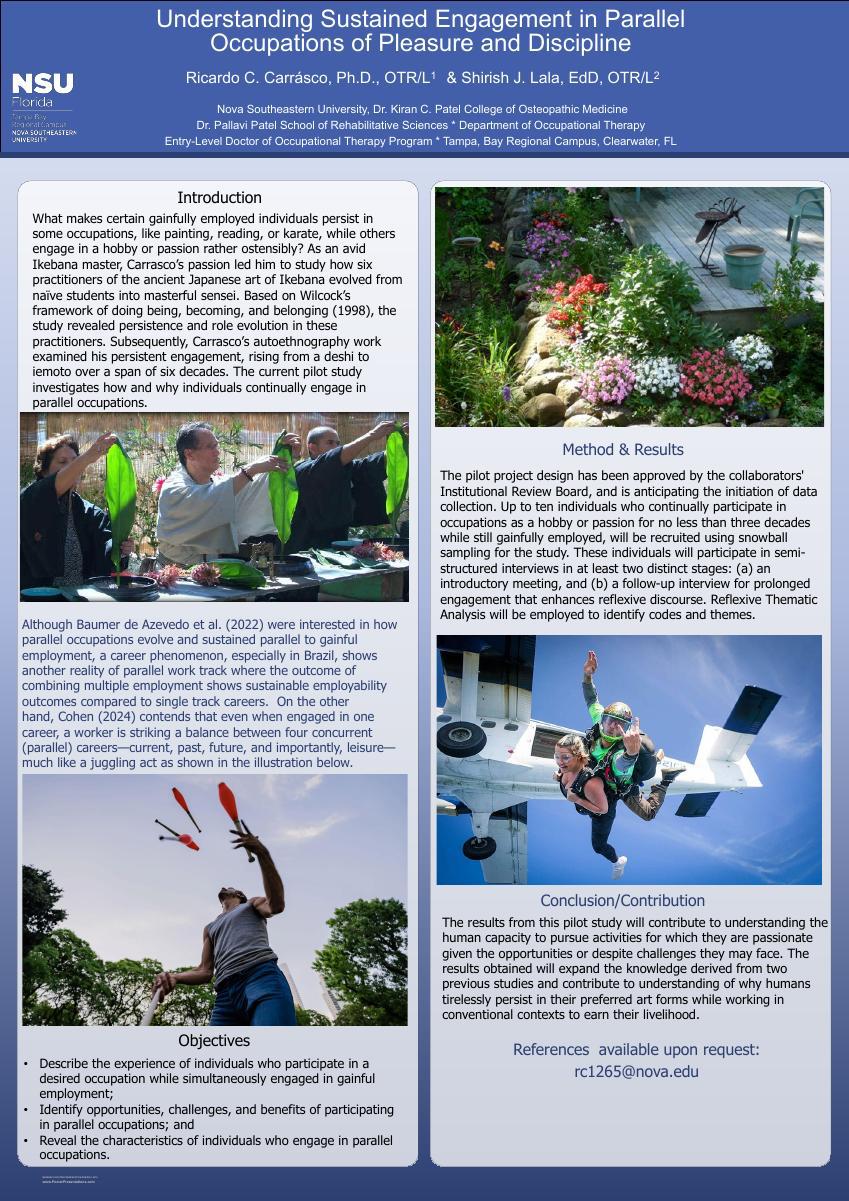
Methods / Results:: Up to ten individuals who continually participate in occupations as a hobby or passion over their lifetime while still gainfully employed, will be recruited using snowball sampling for the study. These individuals will participate in semi-structured interviews in at least two distinct stages. Reflexive Thematic Analysis will be employed to identify codes and themes.
Conclusion / Contribution to the occupational therapy profession: The results obtained will expand on the knowledge derived from two prior studies on the topic, and contribute to the understanding of how and why humans persist in engaging in their preferred occupations while working in conventional contexts to earn their livelihood.
