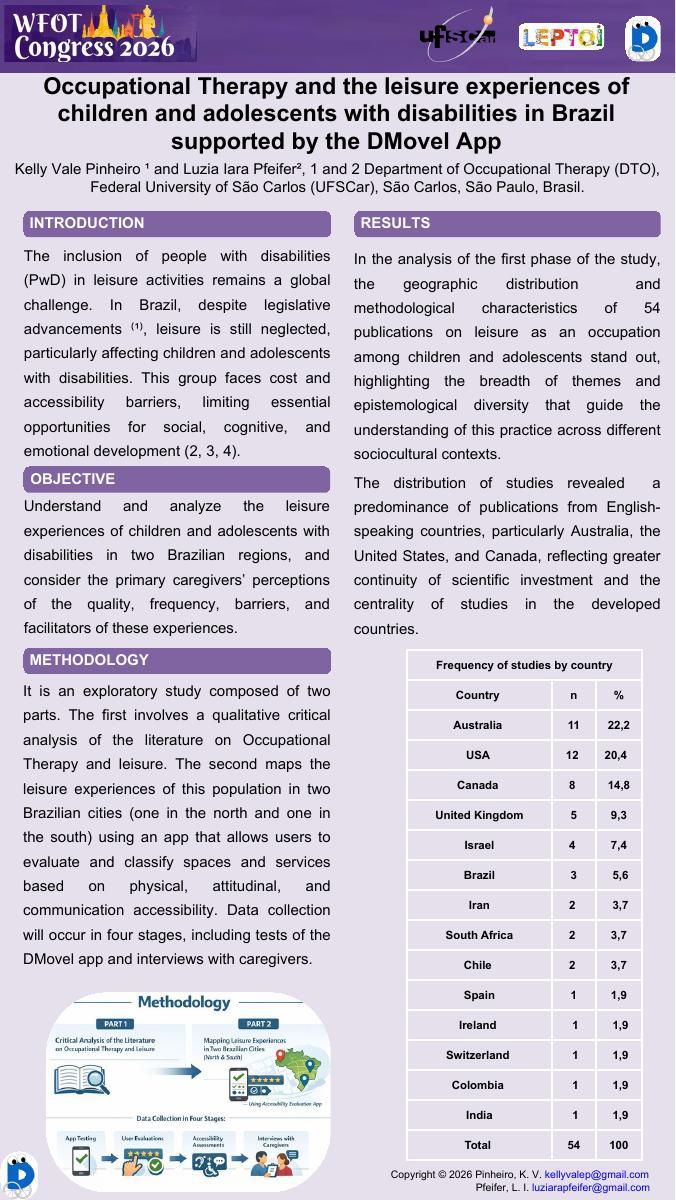
The inclusion of people with disabilities (PwD) in leisure activities remains a global challenge. In Brazil, despite legislative advancements (Brasil, 1988, Lei nº 13.146/2015), leisure is still neglected, particularly affecting children and adolescents with disabilities. This group faces cost and accessibility barriers, limiting essential opportunities for social, cognitive, and emotional development (Sivan, 2021; Queiroz & Morrison, 2023; Carvalho et al., 2024). This study aims to understand and analyze the leisure experiences of children and adolescents with disabilities in two Brazilian regions, considering the main caregivers’ perceptions regarding the quality, frequency, barriers, and facilitators of these experiences. It is an exploratory study composed of two parts. The first involves a qualitative critical analysis of the literature on Occupational Therapy and leisure. The second maps the leisure experiences of this population in two Brazilian cities (one in the north and one in the south) using an application that allows users to evaluate and classify spaces and services based on physical, attitudinal, and communication accessibility. Data collection will occur in four stages, including tests of the D-Móvel app and interviews with caregivers. This research is expected to enhance the understanding of inclusive leisure and accessibility, providing data to support public policies, research, and Occupational Therapy practices. The study aims to contribute to the development and promotion of inclusive leisure, strengthening the social participation of people with disabilities and guiding evidence-based therapeutic interventions.
