
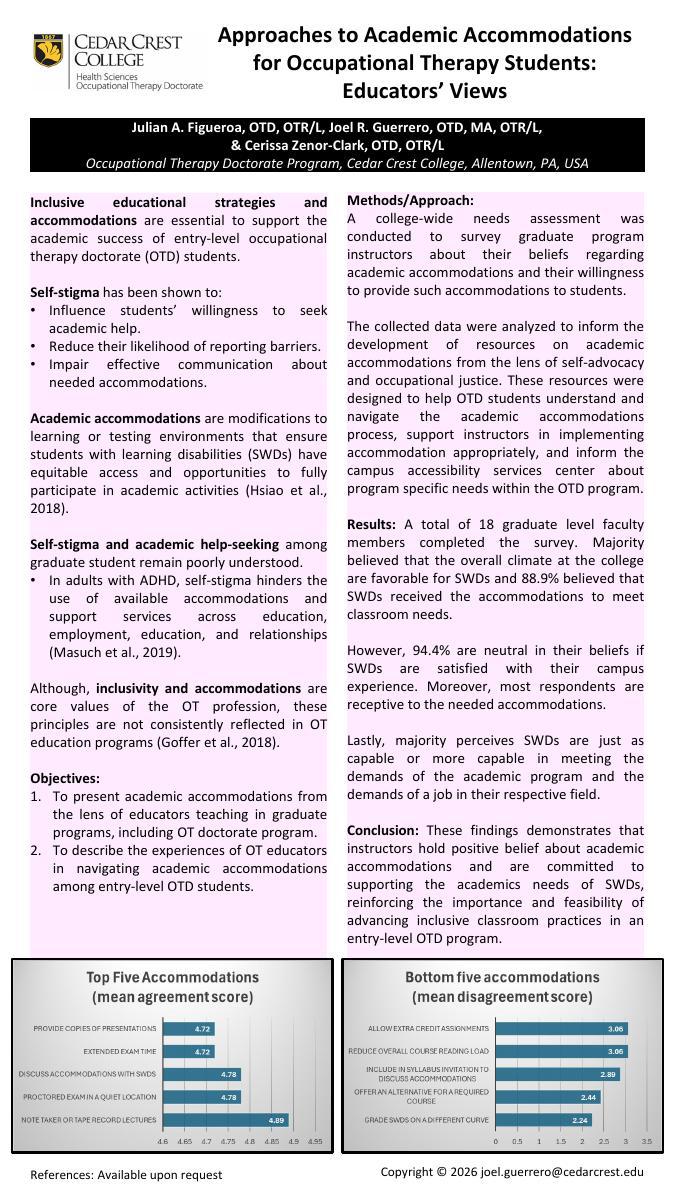
Introduction / Rationale: The education of entry-level occupational therapists requires inclusive educational approaches and accommodations to ensure academic success. Literature has found that self-stigma influences academic help-seeking among students, and negatively impacts their capacity to report academic barriers and effectively communicate their accommodations. Educators play an important role in ensuring that academic accommodations are tailored to the learning needs of the OT students.
Objectives:
1. To discuss academic accommodations from the perspective of educators teaching in graduate programs.
2. To describe the experiences of occupational therapy educators in navigating academic accommodations among entry-level occupational therapy doctorate students.
Methods / Approach: We conducted a college-wide online survey among graduate program instructors to gather data on the knowledge and attitudes toward students needing academic accommodations. Data were analyzed and used to inform the development of resources on academic accommodations from self-advocacy and occupational justice perspectives. These resources aim to guide students, instructors, and the accessibility services center on navigating academic accommodations for occupational therapy doctorate students.
Results / Practice Implications: We will present the results of the survey among instructors, describe the contents of the resources on academic accommodations, and share a case study on navigating academic accommodations for OTD students.
Conclusion / Contribution to the occupational therapy profession: Entry-level OT doctorate students who report having learning disabilities often require academic accommodations. Instructor's knowledge and attitude towards making course-related accommodations could significantly influence students' academic success. Our research study highlights the role of OT educators as equal partners in advocating for OTD students who need academic accommodations.