
Introduction: Visual search tasks are utilized to assess attention functions. However, the absence of targets is common in daily life. Therefore, it is crucial to understand the characteristics of search behavior in these contexts.
Objectives: To elucidate the characteristics of behavior and eye movements in the absence of a target in a visual search task.
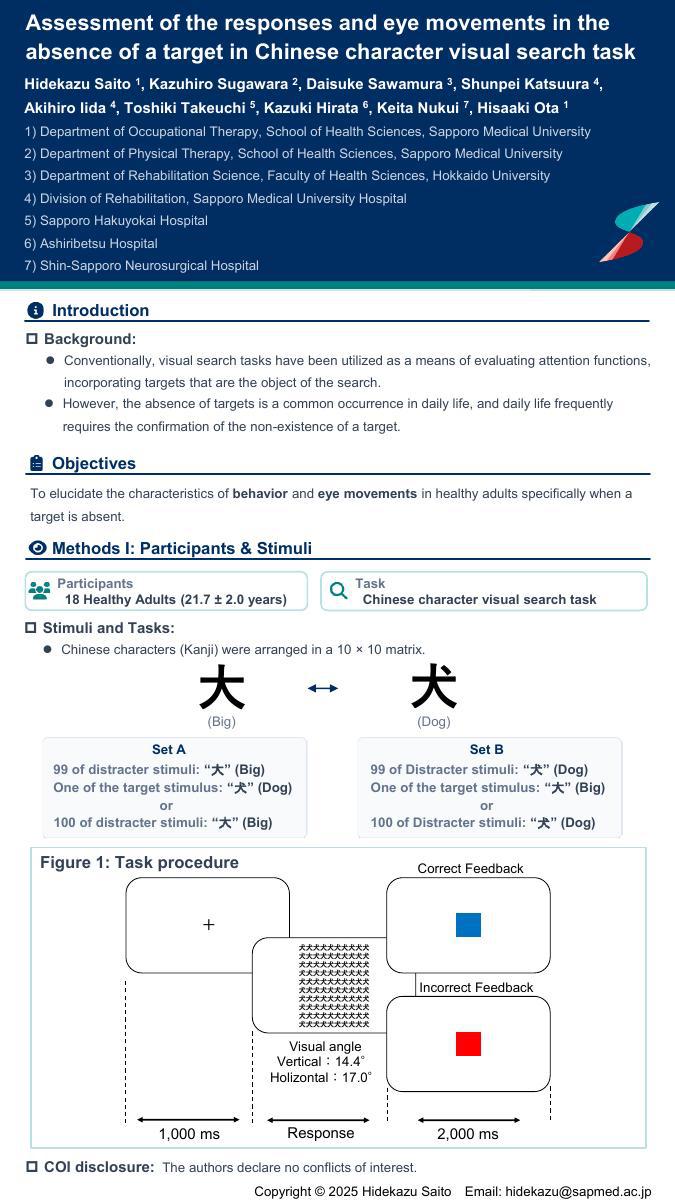
Methods: Eighteen healthy adults (21.7 ± 2.0 years old) participated in this study. The task comprised two conditions: a target-search condition and a non-target condition. In the target-search condition, participants identified a target Chinese character among multiple identical characters that were similar in form to the target. The non-target condition consisted of the same characters, excluding the target. Participants pressed a key corresponding to the presence or absence of the target, and their response times were recorded. Additionally, eye movements during the non-target condition were analyzed, focusing on the area of interest (AOI), which was divided into four quadrants.
Results: Response time was significantly longer in the non-target condition (p < 0.05). In addition, the fixation duration was significantly longer in the upper left AOI compared to the lower left AOI (p < 0.05). However, the number of fixations did not differ significantly between AOIs in the non-target condition.
Conclusion: The observed discrepancy in fixation duration suggests a potential directional bias during character search. This finding will contribute to a better understanding of the characteristics and dysfunction of visual search, and will facilitate the development of effective occupational therapy evaluation.