
Introduction: It has been reported that the prognosis of patients with Human herpesvirus 6(HHV-6) encephalitis is poor, and even those who survive are frequently left with aftereffects such as memory impairment.
Objectives: We report a case in which occupational therapy intervention improved muscle strength, cognitive function, ADL, and QOL after the transplant was complicated by higher cortical dysfunction and severe steroid myopathy.
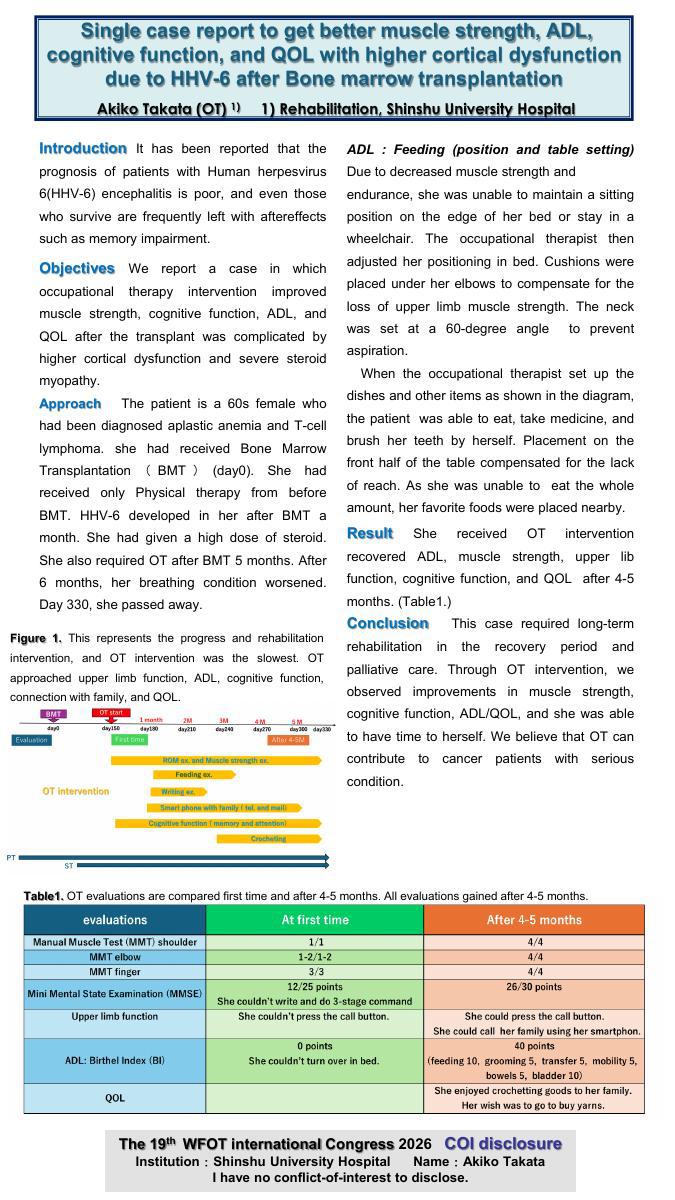
Approach: The patient is a 60s female who had been diagnosed aplastic anemia and T-cell lymphoma. Day 0, She had received Bone Marrow Transplantation(BMT). She had received only Physical therapy from before BMT. HHV-6 developed in her after BMT a month. She had given a high dose of steroid. She also required OT after BMT 5 months. OT evaluation (at first time): Manual Muscle Test (MMT): shoulder1/1, elbow1-2/1-2, finger3/3. Mini Mental State Examination (MMSE):12/25 points. (She couldn’t write and do 3-stage command) Upper limb function: She couldn’t press the call button. ADL: Birthel Index (BI): 0 points. She couldn’t turn over in bed. OT approached muscle strength, cognitive function, ADL, and QOL.
Results: OT evaluation (after 4-5 months): MMT: sholuder4/4, elbow4/4, finger4/4. MMSE:26/30 points. Upper limb function: She could crochet and use a smartphone. ADL: BI: 40 points. QOL: She enjoyed presenting knitted goods to her family. Her wish was to go to buy yarn. After 6 months, her breathing condition worsened. Day 330, she passed away.
Conclusion: This case required long-term rehabilitation in the recovery period and palliative care. Through OT intervention, we observed improvements in muscle strength, cognitive function, ADL/QOL, and she was able to have time to herself. We believe that OT can contribute to cancer patients with seriouss