
Introduction / Rationale: The Self-Care Performance Assessment for Children (SCPAC) is a parent-report questionnaire reflecting Taiwanese cultural self-care performance. However, its 73 items impose a burden on parents, reducing efficiency and increasing error rates.
Objectives: This study aimed to develop a short form of SCPAC using machine learning.
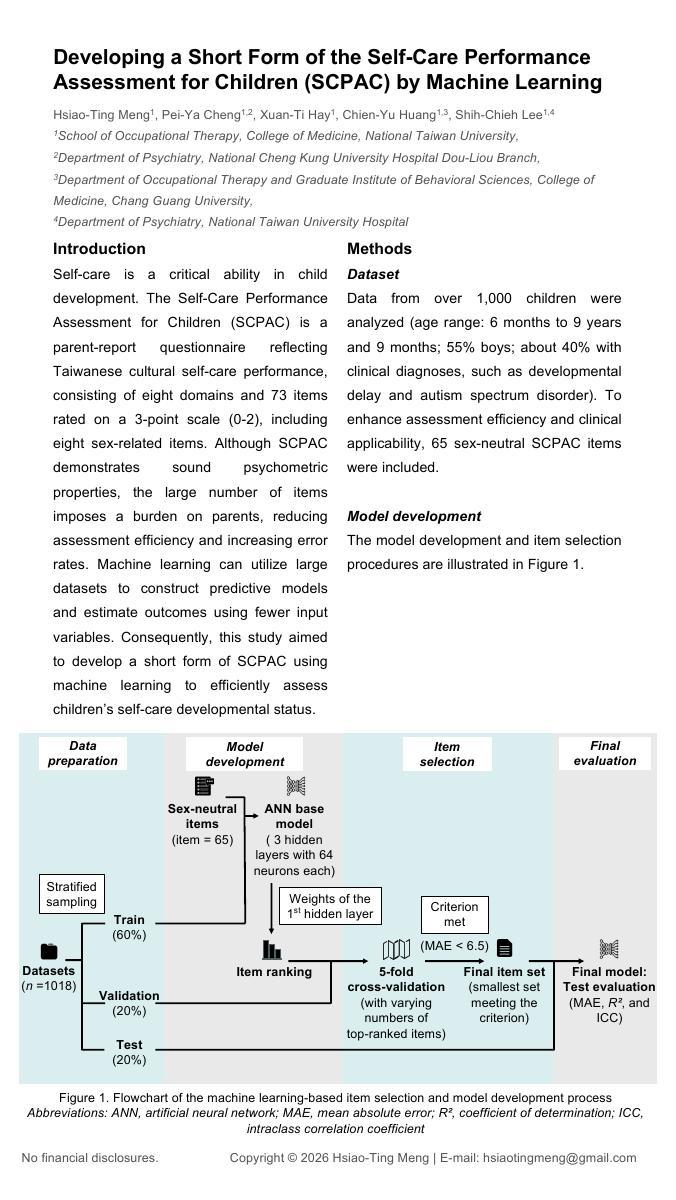
Methods / Approach: Data were collected from social media, schools, and clinics. Of the 73 items, 65 sex-neutral items were analyzed. The dataset was split into training (60%), validation (20%), and test (20%) sets for model training, hyperparameter tuning, and final evaluation. Items were selected based on ranked feature weights from the first hidden layer of a neural network. Models with 10–13 items were tested using 5-fold cross-validation, with a mean absolute error (MAE) threshold of 6.5. The final model was chosen based on the minimal number of items meeting this criterion. The model comprised three hidden layers with 64 neurons each, using the Adam optimizer and a linear activation function. Performance was assessed using MAE, R², and Intraclass Correlation Coefficient (ICC).
Results / Practice Implications: Data from 1,018 children (mean age 6.94±2.97 years) showed the 12-item model performed best (mean MAE=6.15, mean R²=0.93). Cross-validation confirmed excellent performance (MAE=5.96, R²=0.92, ICC=0.98).
Conclusion / Contribution to the occupational therapy profession: The 12-item model accurately predicts SCPAC scores with high reliability. This model can be integrated into an app for clinical use, enhancing efficiency while maintaining precision.