
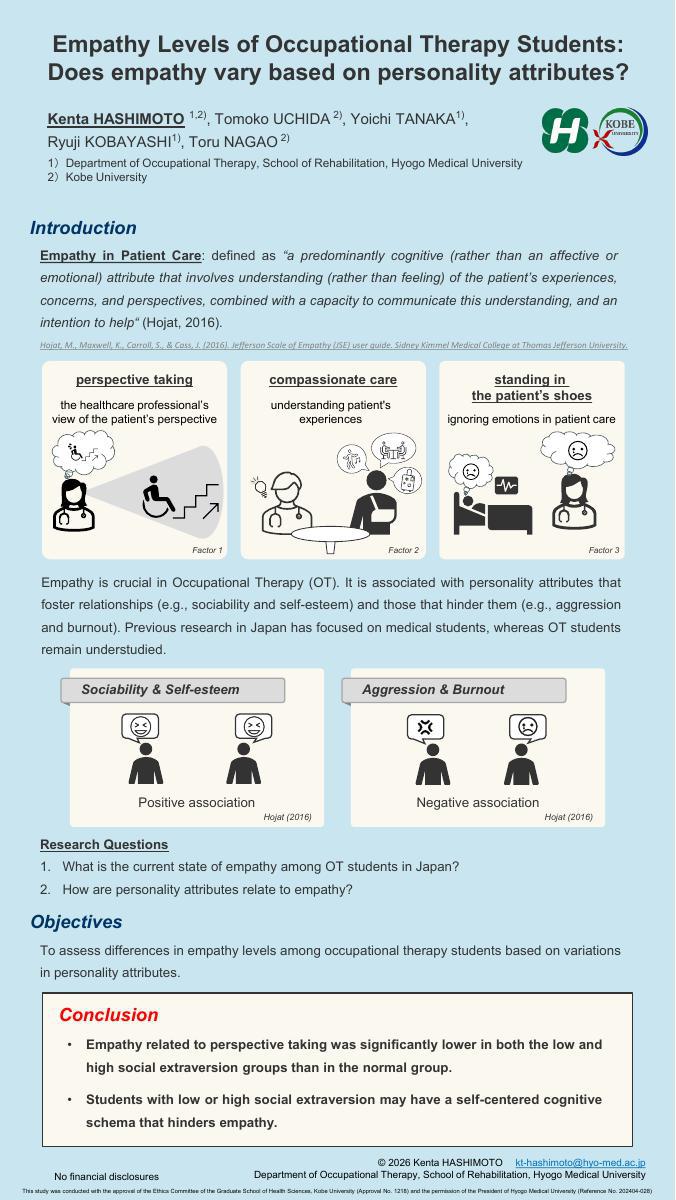
Introduction: Empathy is crucial in occupational therapy. It is associated with personality attributes that foster relationships, such as sociability and those that hinder them, such as aggression and hostility.
Objectives: To assess differences in empathy levels among occupational therapy students based on variations in personality attributes.
Methods: A cross-sectional study was conducted with 163 occupational therapy students at Hyogo Medical University. Empathy was measured using the Jefferson Scale of Empathy-Health Professions Student version (JSE-HPS), and personality attributes were assessed using the Yatabe-Guilford Personality Inventory (YGPI). The JSE-HPS provides total scores and evaluates three factors: Factor 1 (perspective taking), Factor 2 (compassionate care), and Factor 3 (standing in the patient’s shoes). The YGPI assesses 12 personality attributes: depression, cyclic tendency, inferiority feelings, nervousness, lack of objectivity, lack of cooperativeness, lack of agreeableness, general activity, rhathymia, thinking extraversion, ascendence, and social extraversion. Data were collected using paper-based questionnaires with prior written explanations and consent. Tukey’s honestly significant difference test (p<0.05) was used for multiple comparisons.
Results: In total, 130 students participated. No significant differences were found in total JSE-HPS scores across the 12 personality attributes. For Factor 1 of the JSE, scores in the low and high social extraversion groups were significantly lower than those in the normal group (low, 55.3±8.1l; normal, 59.3±6.0; high, 54.9±7.6; low-normal, p=0.040; and normal-high, p=0.026). No significant differences were observed for Factors 2 and 3.
Conclusion: Students with low or high social extraversion may have a self-centered cognitive schema that hinders empathy.