
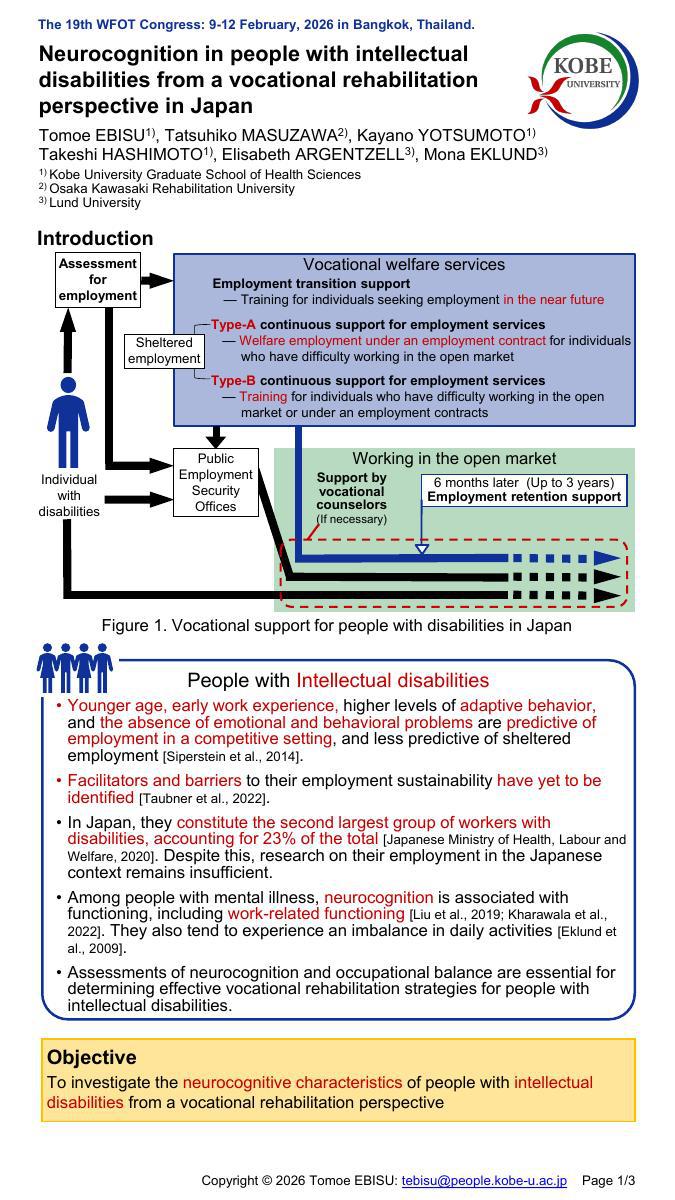
Introduction: Assessments of neurocognition and occupational balance (OB) are crucial for determining vocational rehabilitation strategies for people with intellectual disabilities.
Objective: We aimed to investigate the neurocognitive characteristics of people with intellectual disabilities from a vocational rehabilitation perspective.
Methods: This study was a sub-analysis of a larger study that had been approved by an ethical review board. Subjects in this study were all individuals with intellectual disabilities in the larger study. They underwent the Trail Making Test Part B (TMT-B) and participated in an interview using the Japanese version of the instrument Satisfaction with Daily Occupations and Occupational Balance (SDO-OB-J).
Results: Subjects were six individuals with intellectual disabilities (30–54 years old, three men and three women). Two individuals working in the open market completed the TMT-B in 65 or 186 seconds and had over-occupied or balanced OB. Two who had undergone vocational rehabilitation completed the TMT-B in 57 or 133 seconds, with balanced or under-occupied OB. The remaining two, without vocational rehabilitation, had the longest TMT-B times (224 or 241 seconds) and were under-occupied or over-occupied in OB.
Conclusion: Individuals without vocational rehabilitation had more severe neurocognitive impairments than the others. A wide range of neurocognitive levels was observed among those in both the open market and vocational rehabilitation. For individuals with intellectual disabilities and a certain level of neurocognition, the decision to work in the open market or undergo vocational rehabilitation may not be solely determined by neurocognitive ability.