
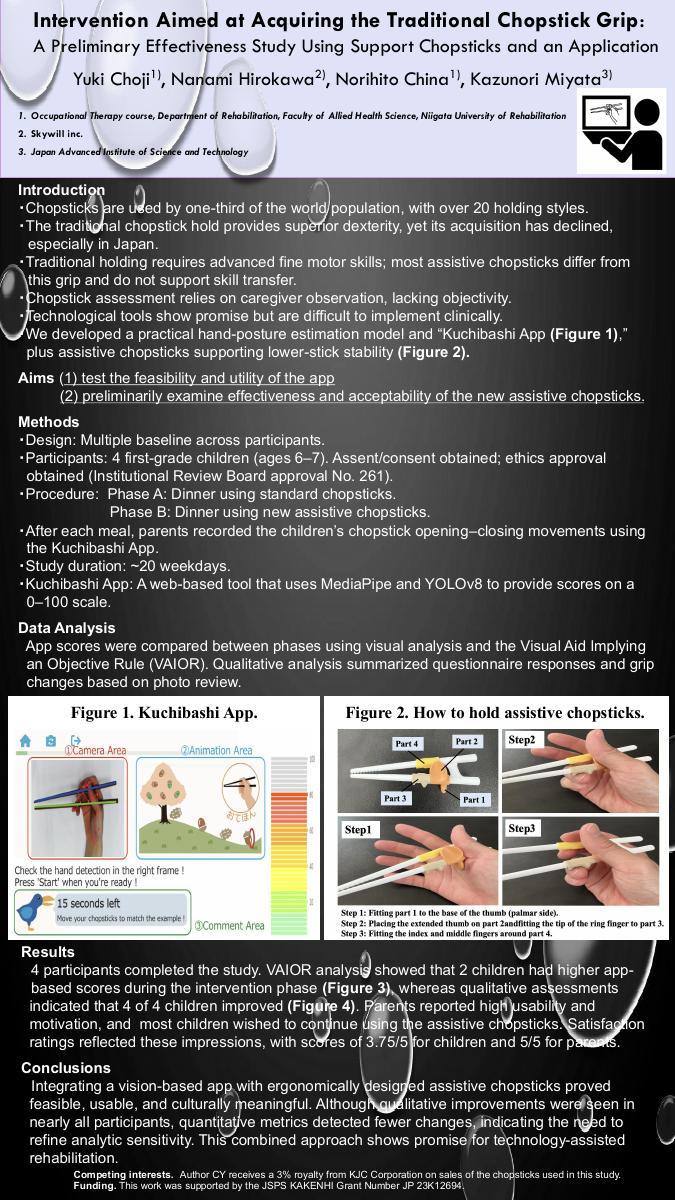
Introduction / Rationale: In Japan, teaching children proper chopstick use has been valued for its role in manners and development. However, nearly half of all children still do not use chopsticks correctly. One reason is that parents, often busy with work, lack time or knowledge to teach traditional usage. Additionally, practice methods are individualized, and assessment is subjective. To address this, the authors developed support chopsticks and an app that objectively evaluates chopstick use.
Objectives: This study aims to preliminarily examine whether support chopsticks can help children acquire the traditional way of holding them.
Methods / Approach: Four first-grade children (ages 6-7; One male, theree females; three right-handed and one left-handed) participated. A multiple baseline design was used, with a baseline phase (A) and an intervention phase (B) where children used support chopsticks during dinners for two weeks. The outcome was measured using the "Kuchibashi App," which applies a hand pose estimation model. Video analysis and questionnaires were also used. Data were analyzed via visual inspection and VAIOR. This study was approved by the Ethics Committee of Niigata Rehabilitation University (No. 261) and followed the Declaration of Helsinki. This work was supported by the JSPS KAKENHI Grant Number JP 23K12694.
Results / Practice Implications: VAIOR showed improvement in two children, and video analysis indicated all improved in traditional holding. Questionnaires highlighted enjoyment due to game elements.
Conclusion / Significance: Support chopsticks effectively helped children acquire traditional usage. Future studies should expand sample sizes and include international comparisons.