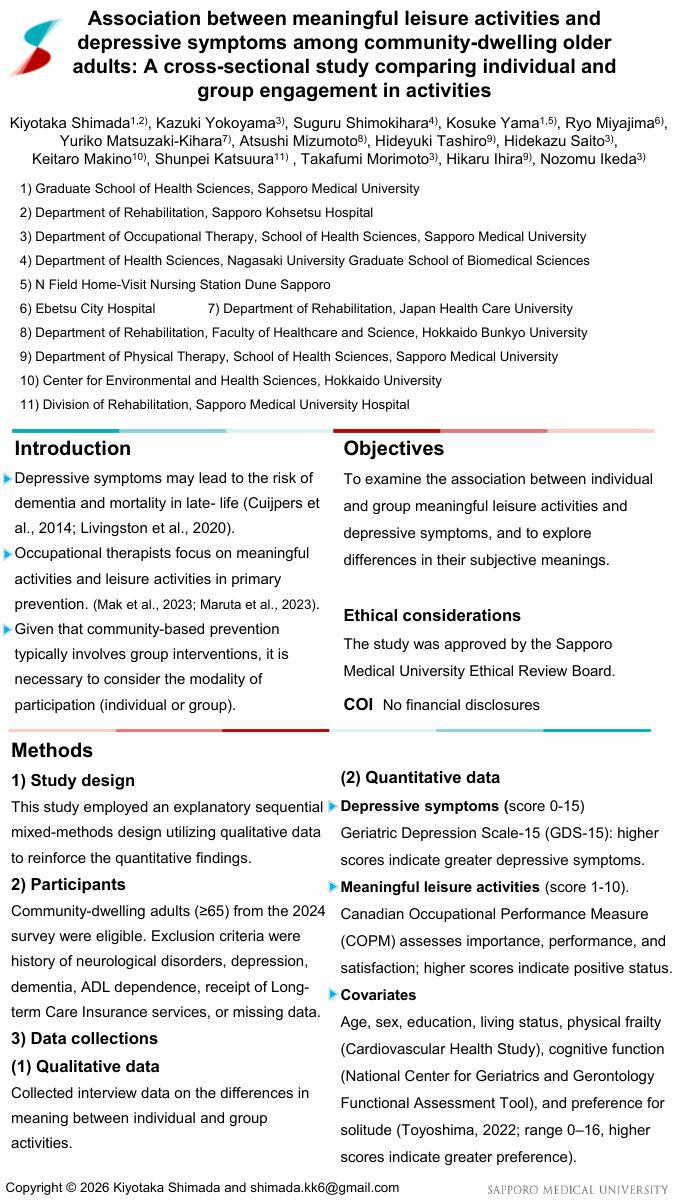
Introduction: Depressive symptoms may lead to the risk of dementia and mortality. Occupational therapists need to treat meaningful leisure activities inferred to be associated with depressive symptoms as primary prevention.
Objectives: This study examined the association between individual or group meaningful leisure activities and depressive symptoms among community-dwelling older adults. Additionally, to reinforce the interpretation of these associations, differences in the subjective meaning of individual or group leisure activities were qualitatively revealed.
Methods: A mixed-methods approach targeted older adults (age ≥65) in a cohort study. Depressive symptoms were assessed by Geriatric Depression Scale-15 (GDS-15). Meaningful leisure activities were measured by Canadian Occupational Performance Measure (COPM), evaluating importance, performance, and satisfaction (score 1-10). Multiple regression analysis was performed with GDS-15 as the dependent variable, COPM as the independent variable, and age, sex, cognitive function, education, physical frailty, living situation, and preference for solitude scale as the covariate. Qualitative analysis of interview data determined the meaning of individual and group leisure activities. The study was approved by the Sapporo Medical University Ethical Review Board.
Results: The analysis included 80 participants (mean age 77.5 ± 4.7, female 73.8%). The importance of individual leisure activities was significantly associated with depressive symptoms (β = -0.37, p = 0.002), whereas group leisure activities were not associated. Qualitative findings indicated that individual leisure activities more frequently provided meanings like autonomy and immersion.
Conclusion: This study suggests that individual leisure activities are crucial for preventing depressive symptoms, although group leisure activities being emphasized for frailty and dementia prevention.
