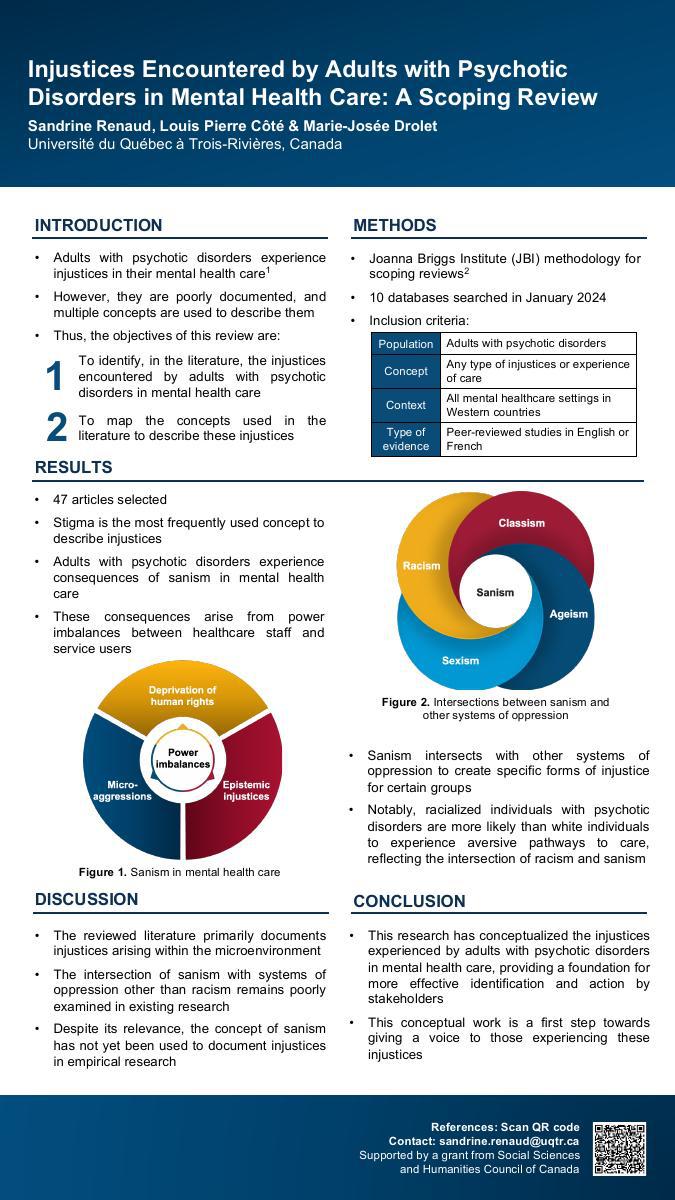
Introduction: According to the World Health Organization, a significant proportion of adults diagnosed with a severe mental disorder, including psychotic disorders, either lack access to mental health care or receive substandard care in high-income countries. While mental health care can support adults with psychotic disorder in their recovery process, it can also contribute to the perpetuation of injustices. To address this issue, the literature has largely focused on the stigma experienced by these people when receiving mental health care. However, injustices extend beyond stigma, as they are also rooted in structural factors and socio-political determinants. For stakeholders to effectively identify and address the injustices encountered by adults with psychotic disorder in mental health care, it is important to clearly conceptualize such injustices.
Objectives: 1) To identify, in the literature, the injustices encountered by adults with psychotic disorder in mental health care; 2) To map the concepts used in the literature to describe these injustices.
Methods: A scoping review following the JBI methodology and the PRISMA-ScR guidelines was conducted. Ten relevant databases were consulted.
Results: Adults with psychotic disorders encounter injustices at multiple levels: in their interactions with healthcare professionals (micro-environment), within the organization of care (meso-environment) and in the broader mental health policies (macro-environment). While stigma remains the most frequently used concept to describe these injustices, other concepts such as discrimination, epistemic injustice, occupational injustice, and sanism are also employed in the literature.
Conclusion: This conceptual work is a first step towards giving a voice to those experiencing these injustices.
