
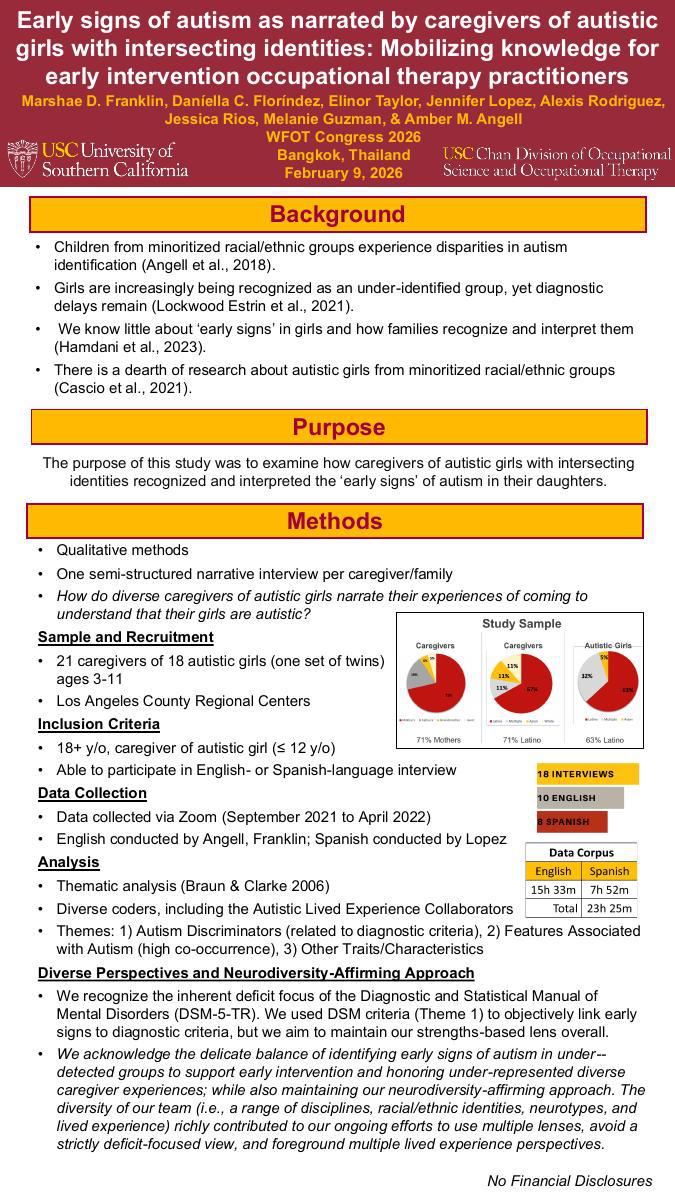
Introduction / Rationale: In the U.S., there are documented racial/ethnic and gender gaps in autism identification, but little is known about how caregivers from racially/ethnically minoritized backgrounds identify and interpret the first signs of autism in girls.
Objectives: This qualitative study examined how caregivers of autistic girls with intersecting identities recognized and interpreted the ‘early signs’ of autism in their daughters.
Methods / Approach: We recruited 21 caregivers of 18 autistic girls (one family had twins) aged 3-11 living in Los Angeles County. Our sample identified as Hispanic/Latino (67%), multi-racial (28%), and Asian (5%). We conducted semi-structured interviews via Zoom (10 in English, 8 in Spanish). We conducted narrative thematic analysis with verbatim transcripts.
Results / Practice Implications: Our analysis yielded eight early signs, categorized into three overarching themes. Theme 1, Autism Discriminators (i.e., related to autism diagnostic criteria), included: 1) common and uncommon restrictive repetitive behaviors, 2) not responding to name, 3) delayed language, and 4) need for sameness. Theme 2, Autism Features (i.e., autistic traits), included: 5) sleep challenges and 6) gastrointestinal and feeding challenges. Theme 3, Other Signs, included: 7) 'fussy babies' and 8) early readers. We identified various ways families interpreted and responded to these signs vis-à-vis family culture and gender expectations, e.g., need for sameness was interpreted as “perfectionism,” and how healthcare providers responded, e.g., ‘let’s wait and see.’
Conclusion / Contribution to the occupational therapy profession: These descriptive findings illuminate ‘early signs’ of autism as identified by caregivers of diverse girls. This knowledge is critical for early intervention occupational therapy practitioners (OTPs) working on multidisciplinary teams, who can advocate for timely early identification, support, and services for this underserved population.