
Introduction/Rationale: Engaging in partnerships with service users or lived experience experts, is increasingly recognised as vital for quality health and disability services, research and education. However, there can be a lack of clarity about the practicalities and priorities in taking action to facilitate partnerships.
Objectives: An exploration of the perspectives, issues and priorities of lived experience experts was undertaken to inform the actions and planning of an occupational therapy journal.
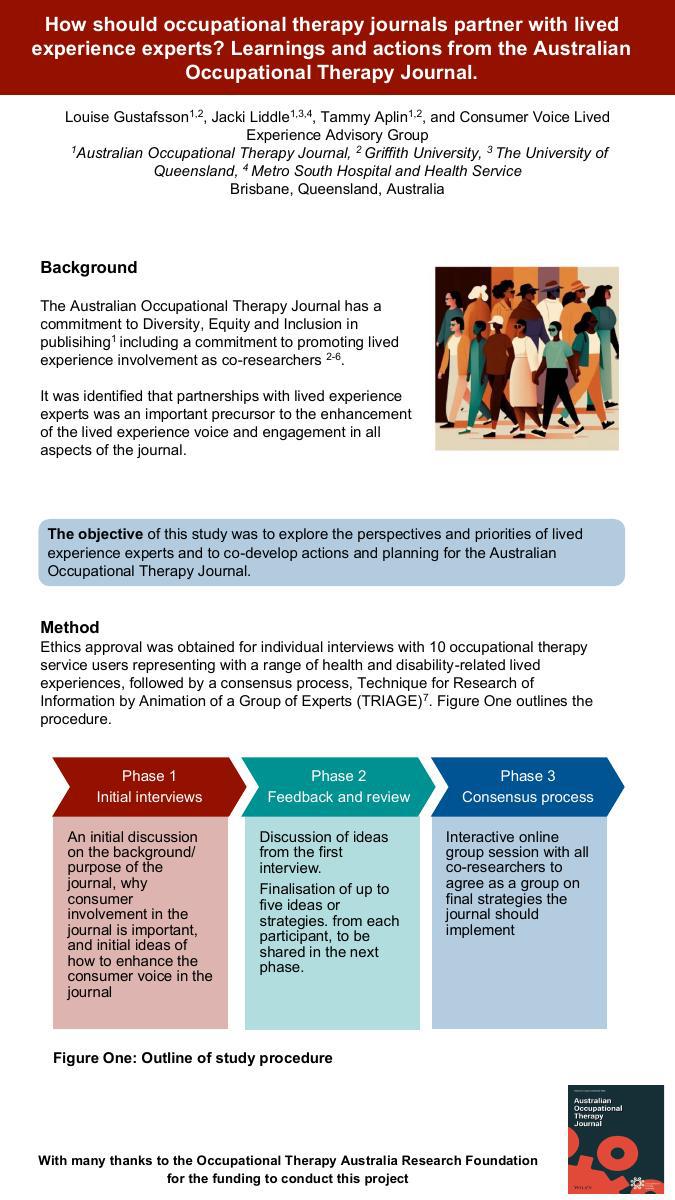
Methods/Approach: .A consensus process (TRIAGE – Technique for Research of Information by Animation of a Group of Experts) was undertaken with 10 people with a range of health and disability related lived experiences who were occupational therapy service users. Individual interviews, checking of synthesised recommendations, and an online group consensus process to prioritise actions were undertaken.
Results/Practice Implications: While the concept of direct engagement with occupational therapy journals was generally seen positively, inherent complexities within academic publishing that limited partnership were also noted. Mutual skilling up, resourcing and genuine and ongoing engagement were seen as important initial steps. Priority actions included the requirement of easy-to-read summaries in published papers, changes to author guidelines, and involvement of lived experience experts within advisory roles to the board.
Conclusion / Contribution to the occupational therapy profession: There were numerous actions suggested by lived experience experts to enable a true collaborative approach to the publishing of occupational therapy journals. These actions may be explored by other organisations internationally, with local lived experience experts, to help ensure impactful partnerships and the building of relevant evidence.