
Introduction/Rationale: International students experience various difficulties in participating in academic, social and cultural contexts. These students are often at risk of occupational injustice.
Objectives: This study aims to explore the perspectives of international university students regarding occupational injustice and associated factors in Turkey.
Methods/Approach: Semi-structured interviews were conducted with nineteen international university students in Turkey. The participants' experiences and perspectives on occupational justice and related factors were analyzed through thematic analysis.
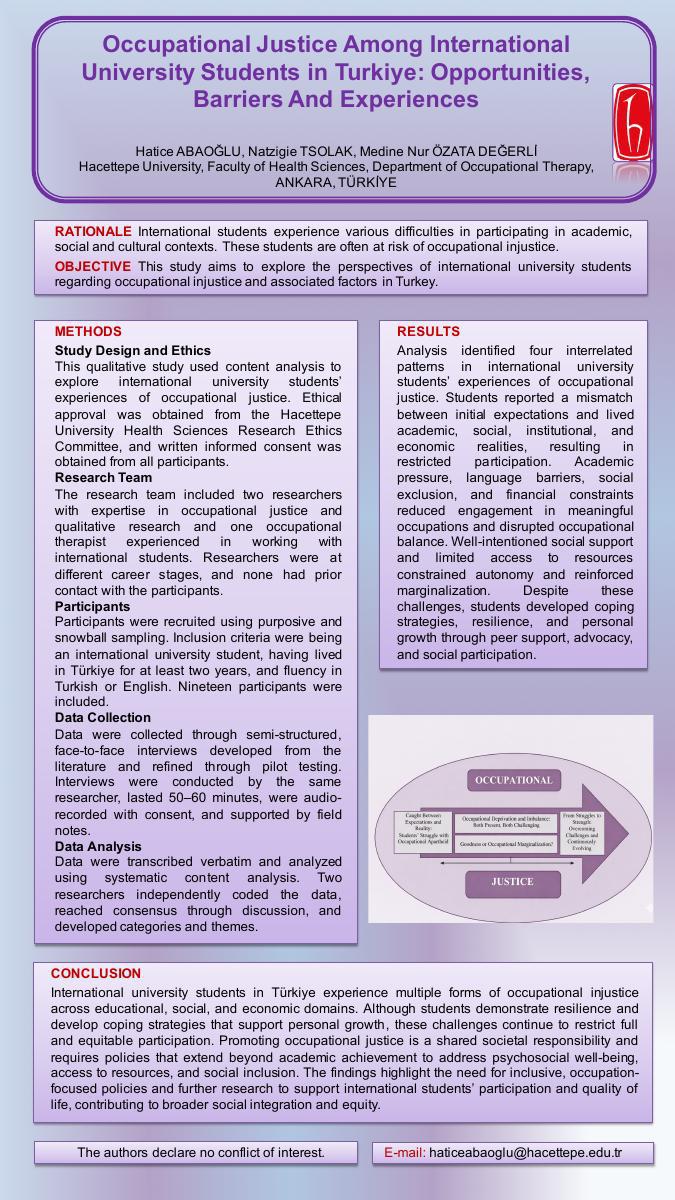
Results/Practice Implications: Four main themes emerged from the analysis: “Caught Between Expectations and Reality: Students’ Struggle with Occupational Discrimination”, “Occupational Deprivation and Imbalance: Both Present, Both Challenging”, “Goodness or Occupational Marginalization?”, and “From Struggles to Strength: Overcoming Challenges and Continuously Evolving”. International students initially perceived studying in Turkey as a great opportunity, but faced social, academic, and economic challenges. Occupational discrimination due to language barriers, cultural differences, and appearance led to restrictions in academic and social life. Students experienced occupational deprivation and imbalance due to marginalization, financial difficulties, and social isolation. However, they developed resilience, built support networks, and acquired new skills to cope with these challenges. Despite the hardships, these experiences contributed to their personal growth, enhancing problem-solving abilities, empathy, and adaptability while fostering confidence and cross-cultural friendships.
Conclusion/Significance to the Occupational Therapy profession: Addressing these occupational injustices can support international students’ social integration, autonomy, and overall well-being. Occupational therapy professionals can play a key role in improving these students' quality of life by promoting equitable participation in both academic and social contexts.