
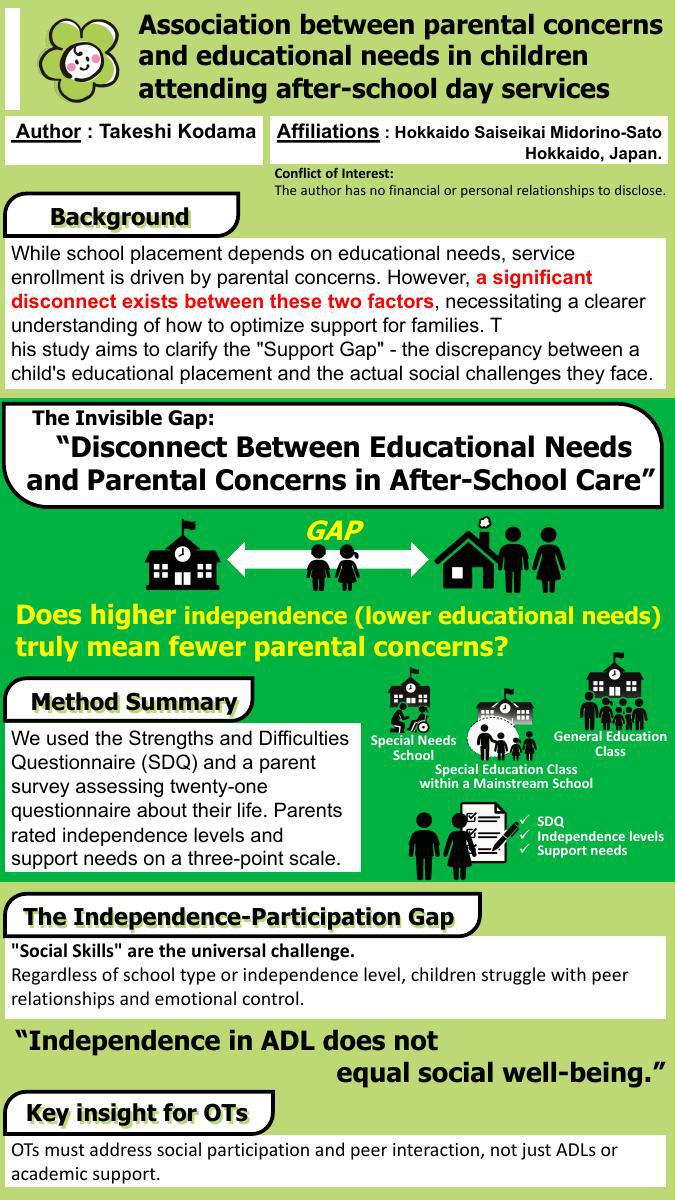
Introduction: After-school day services in Japan provide inclusive support for children with diverse educational needs. While school placement is determined by educational needs, enrollment in these services depends primarily on the intensity of parental concerns. Our facility supports 87 children, implementing small-group occupational therapy and Positive Behavior Support (PBS) as core interventions. This study examines the relationship between school classification, parental concerns, and children's independence to optimize support strategies.
Methods: We used the Strengths and Difficulties Questionnaire (SDQ) and a parent survey assessing six ADL, four IADL, six language, and five social skills items. Parents rated independence levels and support needs on a three-point scale. Data distribution was analyzed by school classification using ANOVA, and multiple regression analysis assessed the effects of school type and age.
Results: Lower educational needs were associated with higher independence and reduced parental concerns (p < 0.05). A significant correlation was found between SDQ scores and educational needs (F = 3.434, p = 0.038). However, social skills-related independence showed no significant difference across school types.
Discussion: Educational needs influence independence and parental concerns. While children with higher needs require extensive support, those with lower needs exhibit greater independence but face social difficulties. Small-group occupational therapy and PBS-based interventions may enhance self-sufficiency and social adaptation, highlighting the need for targeted support in after-school programs.