
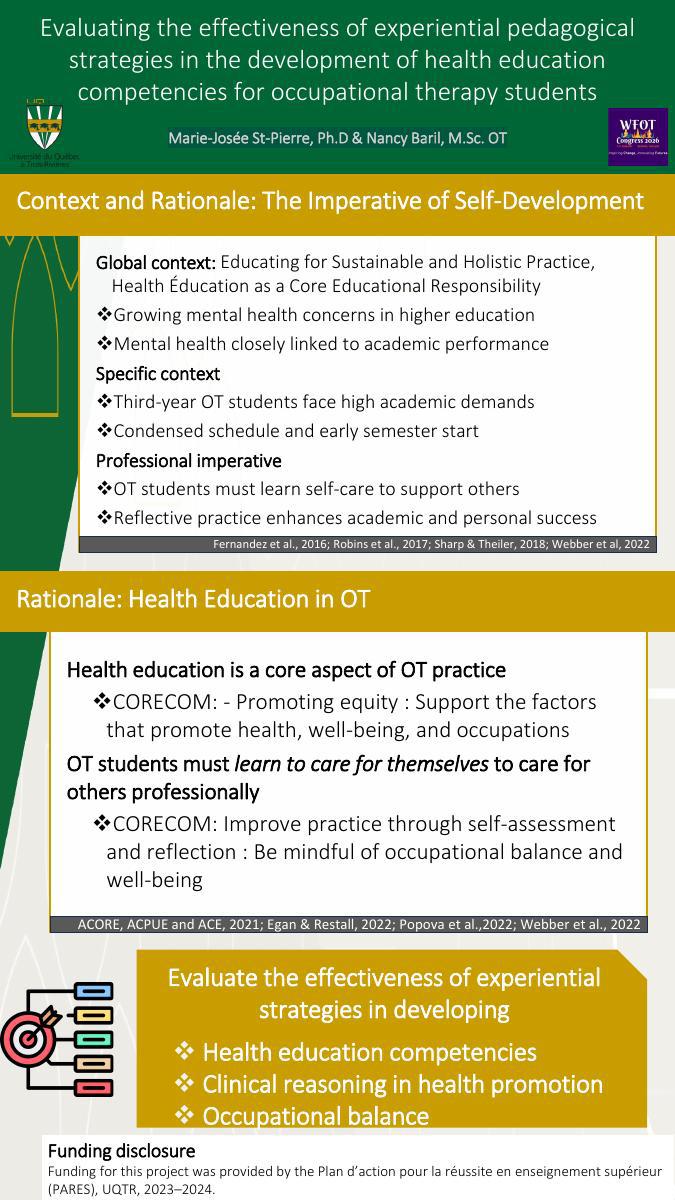
Rationale: Developing health education competencies for future occupational therapy professionals is crucial for promoting global, holistic, and sustainable health. In the context of rising global health challenges, it is essential to put strategies in action to preserve student’s health in a learning environment (learner) and learn to take care of oneself to offer competent occupational therapy practice (professional). However, there is limited documentation on pedagogical strategies that develop these competencies.
Objectives: This study evaluates the effectiveness of experiential pedagogical strategies, centered on reflective practice and evidence-based health education, within an Occupational Therapy Health Prevention and Promotion course for the development of health education competencies of undergraduate students.
Methods : Utilizing a Scholarship of Teaching and Learning (SoTL) framework (Bélisle, Lison et Bédard, 2016, adaptée d’O’Brien, 2008), we assessed how the experiential pedagogical strategies contribute to students' acquisition of essential health education competencies and guide improvements in teaching practices.
Results: Preliminary findings suggest that experiential learning significantly enhances students' ability to apply health education principles. Key findings also emphasize the importance of combining these strategies with a supportive learning environment, role modeling by instructors, and opportunities for students to develop competencies throughout curriculum and fieldwork.
Conclusion: This research offers insights into optimizing health education within occupational therapy curricula, contributing to both student health and the development of healthy competent future practitioners.