
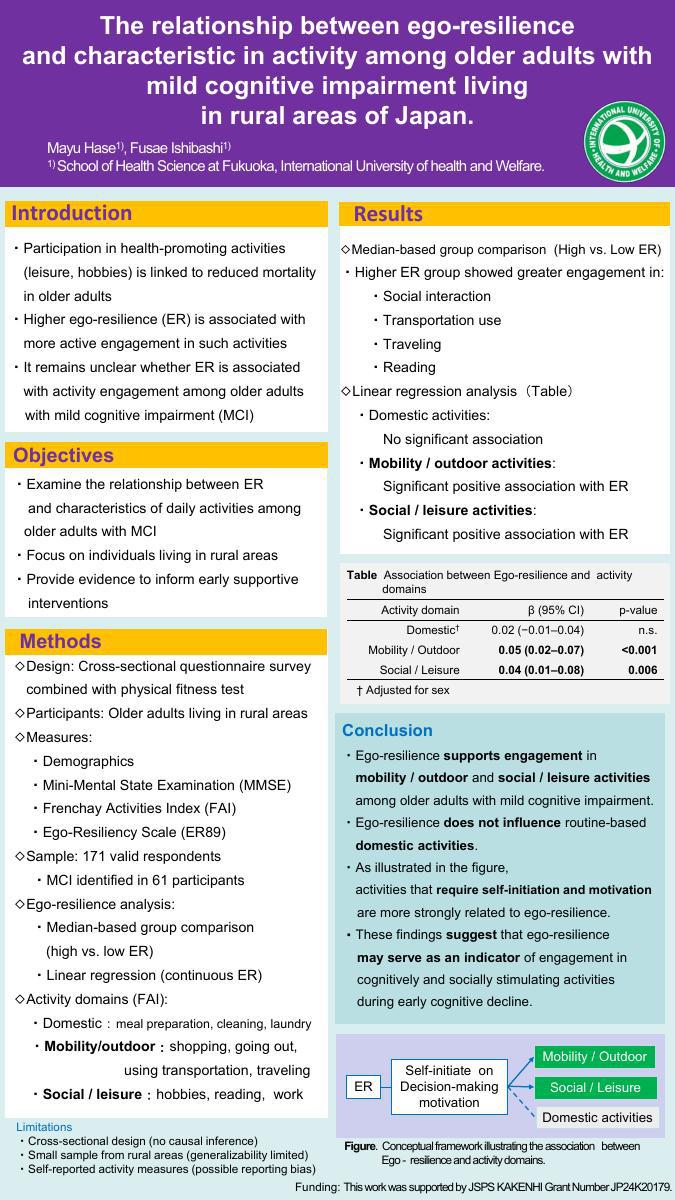
Introduction: Participation in health-promoting activities such as leisure and hobbies among older adults is associated with reduced mortality. Among independent older adults living in the community and those with mild care needs, high ego-resilience scores are associated with a characteristic of people who actively participate in these health-promoting activities.
Objectives: The aim of this study is to determine whether ER is related to the process of engaging in health-promoting activities even in older people with mild cognitive impairment (MCI), and to consider an early support program by understanding the characteristics of these activities.
Methods: A questionnaire survey was conducted among 151 older people living in rural areas who participated in a physical fitness test. The survey items included basic attributes, subjective health status, whether they had roles, daily routines, and someone to talk to, MMSE, Frenchy Activities Index, and the Ego-Resiliency Scale (ER89). There were 149 valid responses and 49 individuals were identified as having MCI. The data were divided into two groups based on high and low median ER89 scores.
Results: The group with higher ER scores had significantly higher scores for having friends, using transportation, traveling, and reading. Multiple logistic regression analysis showed that reading was the preferred option.
Conclusion: This finding suggests that when older people with high ER become aware of cognitive decline, they turn to reading as a coping behavior to maintain cognitive function. Acquiring new information through reading helps maintain and improve cognitive function and maintains curiosity, suggesting that it may be a personal strategy for slowing the progression of cognitive impairment.