
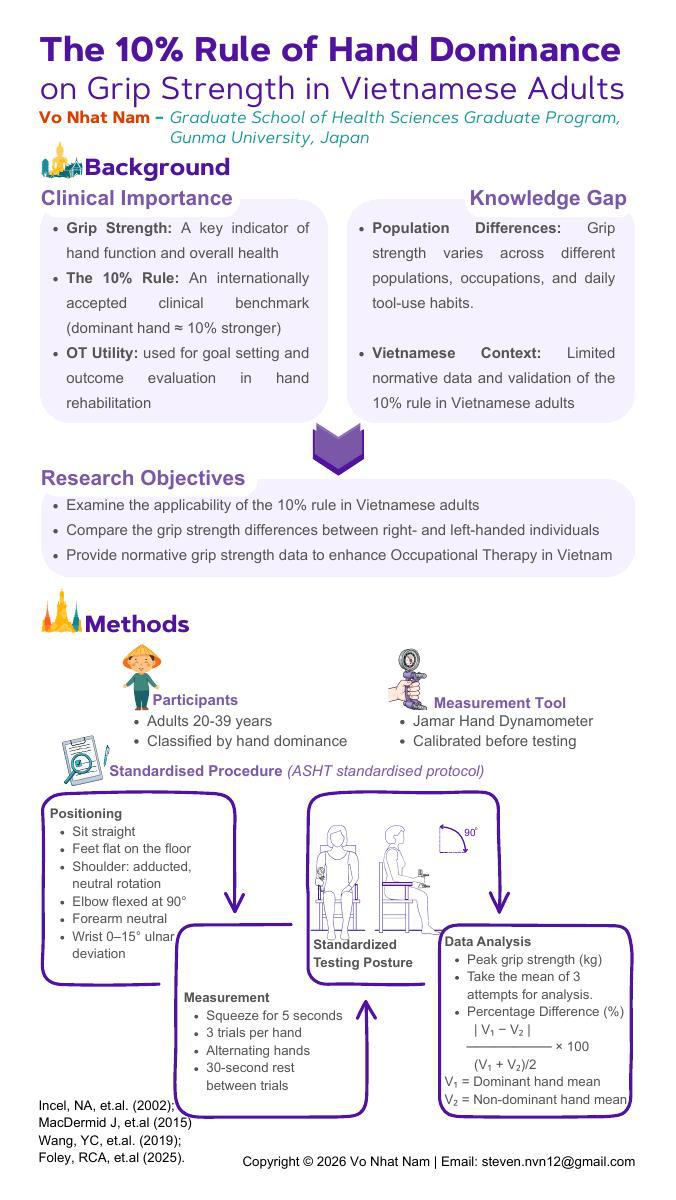
Introduction: Hand grip strength is crucial for daily activities and has evolved due to tool use and handedness. In hand rehabilitation, the 10% rule suggests that the dominant hand typically has 10% greater grip strength than the non-dominant hand, aiding occupational therapy professionals in setting goals and treatment plans for patients with hand injuries.
Objectives: Determine whether the dominant hand has 10% more grip strength than the non-dominant hand, assess its alignment with the 10% rule, and investigate whether this rule applies equally to both right-handed and left-handed individuals.
Methods: Participants were categorised as either right or left-hand dominant. They were seated on a chair with a straight back and armrest, ensuring proper posture with feet flat on the floor, shoulders adducted and neutrally rotated, and elbows flexed at 90°. Each participant held the Jamar and performed three attempts, alternating between the right and left hand.
Results: A total of 120 healthy individuals. There was a 9.55% difference between the dominant and non-dominant hands, which is approximately 10%. Among right-handed individuals (n = 84), the mean percentage difference was 10.32%, while no significant difference was found for left-handed individuals (p = 0.42). When analyzed by gender, right-handed men (n = 48) had a mean difference of 9.11%, whereas right-handed women (n = 41) showed a higher difference of 14.67%.
Conclusion: This study supports that the dominant hand is about 10% stronger. This study supports that the dominant hand is about 10% stronger, but the relationship may differ for individuals with upper extremity abnormalities, particularly left-handed individuals.