
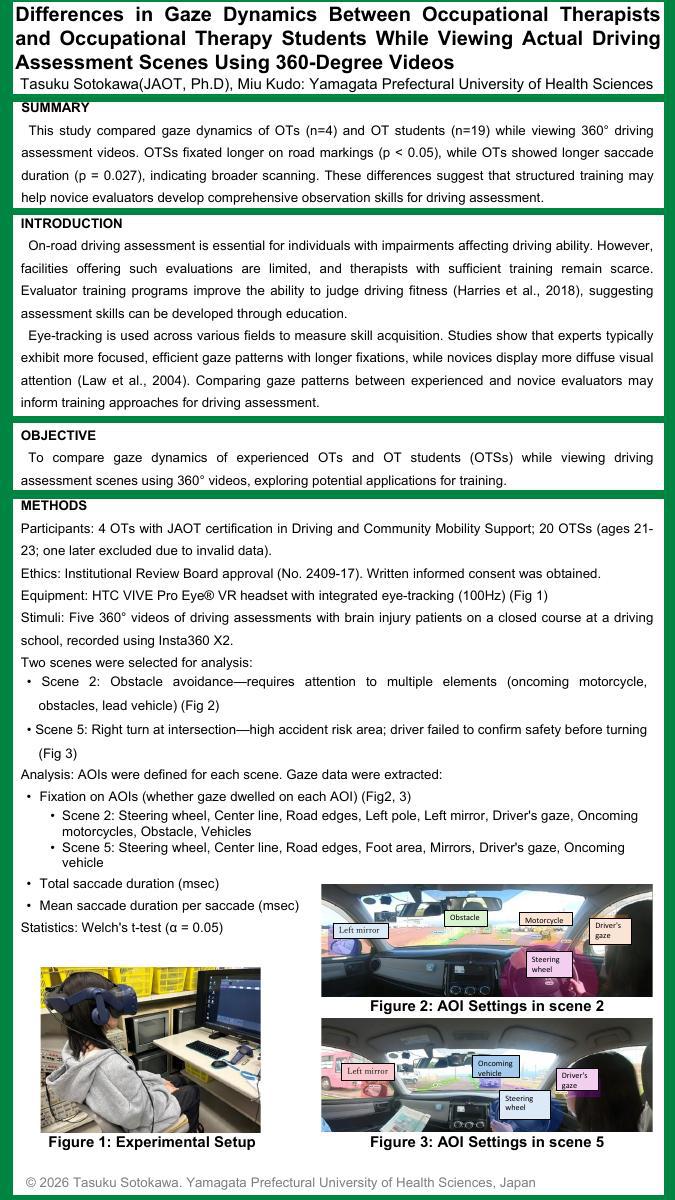
Introduction: Driving is an essential means of mobility, particularly in rural areas with high car dependency. Occupational therapists (OTs) assess driving capabilities, primarily for individuals with neurological impairments. However, practical training opportunities for conducting evaluations remain limited. Eye-tracking studies in medical diagnostics, aviation, and driving safety suggest that experts exhibit distinct gaze behaviors compared to novices, influencing training approaches for driving assessments.
Objective: This study aimed to compare the gaze dynamics of experienced OTs and occupational therapy students (OTSs) during a simulated driving assessment using 360-degree videos, to explore potential applications for training.
Methods: Four OTs with experience in driving assessments and 19 OTSs viewed five real-world driving scenarios via HTC VIVE Pro Eye®. Gaze data, including fixation duration and saccade time, were recorded and analyzed. All participants provided written informed consent. Ethical approval was obtained from the Institutional Review Board of an affiliated institution (Approval No. 2409-17).
Results: OTs exhibited longer saccade durations (p = 0.027), suggesting broader visual scanning, while OTSs fixated more on specific Areas of Interest (AOIs), such as the centerline and left lane boundary (p = 0.011, p = 0.037, p = 0.010, p = 0.029). This suggests that OTSs may struggle to determine key visual information during assessments.
Conclusion: The findings indicate that experienced OTs scan environments more comprehensively, whereas OTSs focus more narrowly. These differences underscore the need for structured training to improve OTSs' hazard perception and driving evaluation skills, contributing to the development of competent evaluators in driving rehabilitation.