
Objective: The purpose of this study is to investigate the occupational therapy professional identity in Taiwan.
Introduction: Professional identity refers to the formation of professional self-image and professional personality by internalizing professional values, knowledge system, and ideology in the social structure. Positive professional identity promotes professional members to commit to the profession and continue to work. Studies have shown that the deeper a person's professional identity, the more positive work experience and better work performance he or she will have.
Methods: We invited occupational therapy college students and occupational therapists to participate in the survey online. An informed consent form was signed before they engage in the survey. A total of 633 subjects participated. The mean age of the subjects were 26.16 years old (SD = 8.8 years old), and there were 484 females, accounting for 76.5%.
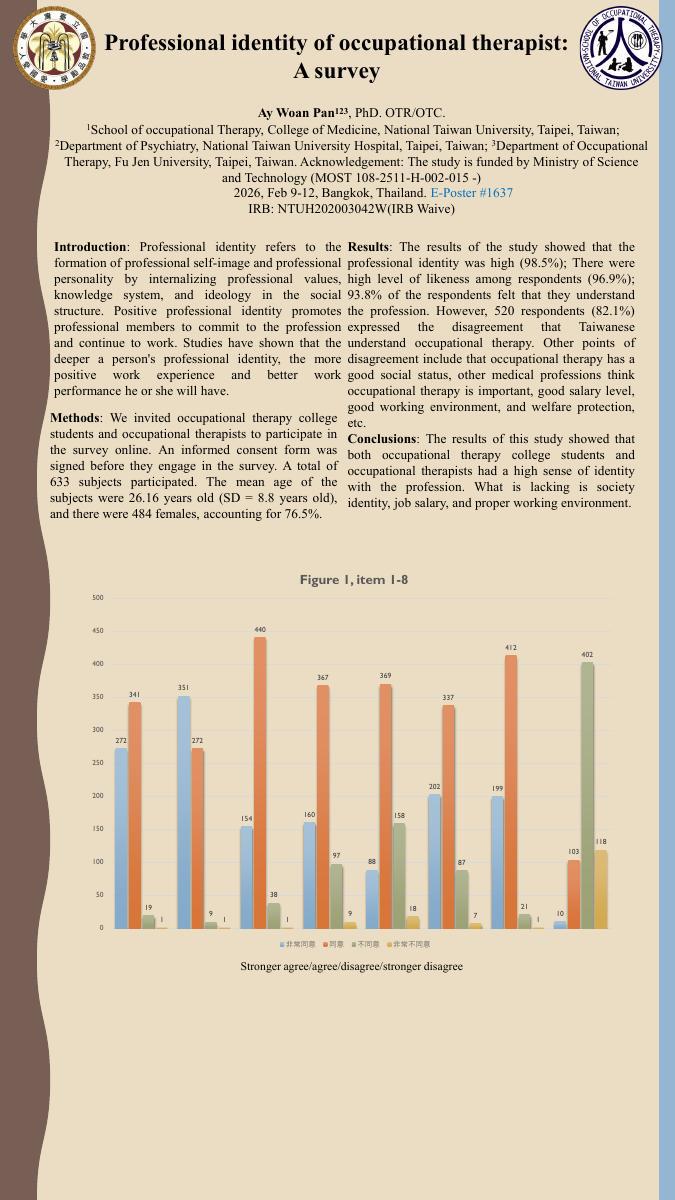
Results: The results of the study showed that the professional identity was high (98.5%); There were high level of likeness among respondents (96.9%); 93.8% of the respondents felt that they understand the profession. However, 520 respondents (82.1%) expressed the disagreement that Taiwanese understand occupational therapy. Other points of disagreement include that occupational therapy has a good social status, other medical professions think occupational therapy is important, good salary level, good working environment, and welfare protection, etc.
Conclusions: The results of this study showed that both occupational therapy college students and occupational therapists had a high sense of identity with the profession. What is lacking is society identity, job salary, and proper working environment.