
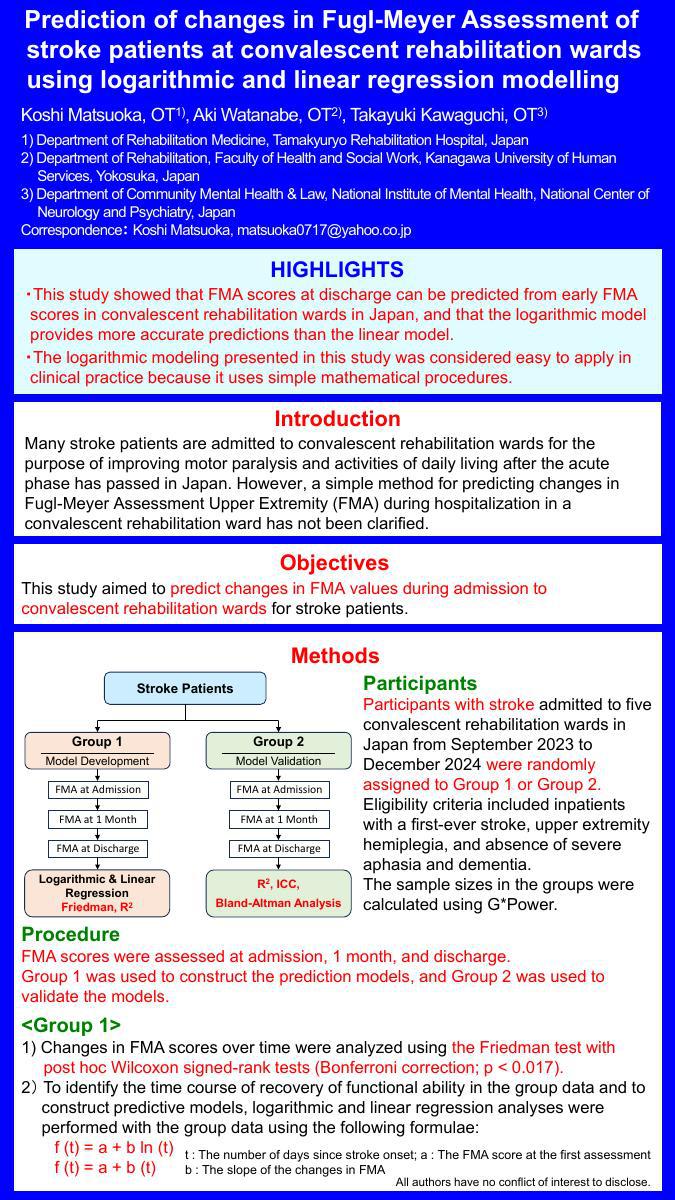
Introduction: Many stroke patients are admitted to convalescent rehabilitation wards in Japan; however, a simple method for predicting changes in Fugl-Meyer Assessment (FMA) during hospitalization has not been clarified.
Objectives: This study aimed to predict changes in FMA values during admission to convalescent rehabilitation wards for stroke patients.
Method: Stroke patients admitted to convalescent rehabilitation wards were randomly divided into two groups to account for sample size. For Group 1, the FMA was measured at admission, one month later, and at discharge, and logarithmic and linear prediction equations were calculated from the two time points at the time of admission and one month later. Furthermore, for both groups, concordance between the predicted and actual values was confirmed, and Bland-Altman analysis was performed. This study was approved by the Ethics Committee of our hospital.
Results: Eighty-two inpatients admitted with stroke across five convalescent rehabilitation wards were registered for the study. In Group 1 (n=49), the R2 between the actual and predicted FMA scores at discharge was higher in the logarithmic (R2=0.880, p<0.001) than the linear regression models. In Group 2 (n=33), the concordance for R2 and ICC were higher for the logarithmic (R2=0.861, ICC=0.919, both p<0.001) than that for the linear regression models. Furthermore, the Bland–Altman plots of the actual and predicted FMA scores showed that 97% of the logarithmic and linear data were within the limits of agreement.
Conclusion: These results suggest that logarithmic modeling can be used to accurately predict changes in FMA scores in convalescent rehabilitation wards.