
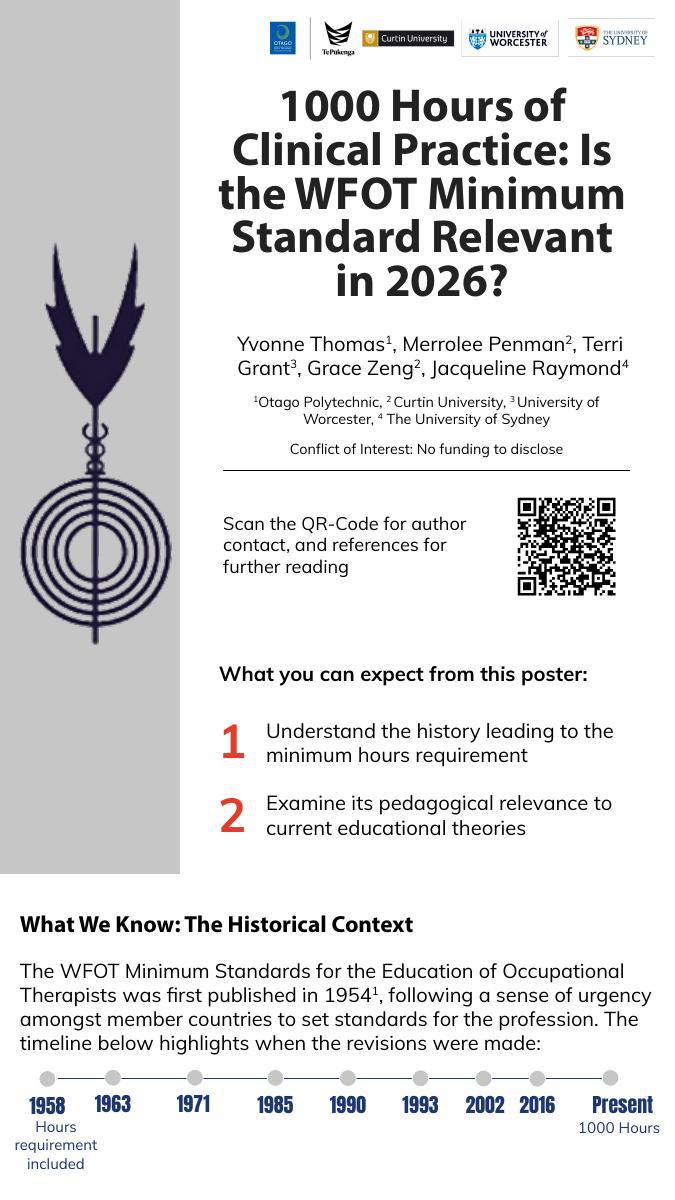
Introduction / Rationale: WFOT’s Minimum Standards for occupational therapy education were first published in 1958, with revisions in 1963, 1971, 1985, 1990, 2002, and 2016. A specified minimum number of hours of clinical practice has been included in the Minimum Standards since 1958, although the number of hours has changed over time.
Objectives: The aim of this study was to investigate the history of the minimum hours requirement and its pedagogical relevance to current education theories.
Methods / Approach: We reviewed historical WFOT documents held at the Wellcome Library(London), original documents held in the US, Sweden and Australia, and information from other sources.
Results / Practice Implications: Key documents dating back to 1935 have influenced the development of the Minimum Standards. Initially, the Minimum Standards were considered essential to developing an autonomous profession. The development of new education programmes globally, required international movement of occupational therapists, to grow the occupational therapy profession and ensure consistency of practice.
Pedagogically, the minimum hours requirement reflected an apprenticeship model of practical learning, popular in the early 20th century. Additionally, the influence and dominance of predominantly Western occupational therapy educators, in the development of the standards was clearly identified.
Conclusion / Significance to the Occupational Therapy Profession: Our findings challenge the relevance of a minimum hours requirement and propose that in line with more current pedagogical theory, it should be replaced with a focus on student competency, based on the cultural context of the country of the educational programme.