
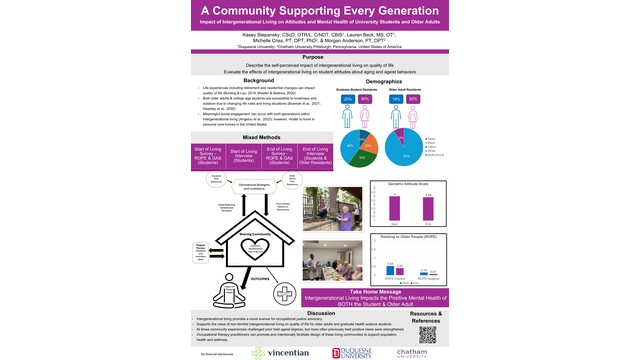
Introduction/Rationale: An intergenerational community places emphasis on social interaction and exchange across generations. Community interaction increases self-esteem, decreases feelings of social isolation, and promotes overall health. This study aims to investigate self-reported outcomes of a novel intergenerational living learning community within a personal care home that provides residence to graduate health science students and older adults.
Objectives: Describe at least two self-reported outcomes associated with intergenerational living.
Compare and contrast perceptions of health science students and older adults regarding benefits and limitations of intergenerational living.
Methods/Approach: This mixed methods study reports pre/post self-reported impact on ageism and quality of life for health science students (HS) and older adults (OA). Quantitative analysis includes pre/post comparison of HS attitudes/ageism using the Relating to Older People Evaluation (ROPE) and the Geriatric Attitude Scale (GAS). Qualitative descriptive analysis was completed on semi-structured interviews with the HSs and OAs using individual content analysis followed by consensus coding to validate themes.
Results/Practice implications: No significant differences were found in HS ageist attitudes and behaviors, however triangulated with qualitative results indicates that a ceiling effect may have impacted meaningful change. Qualitative results provide rich descriptions of individuals generational knowledge, building of authentic relationships, and outcomes of the living situation impacting the positive mental health of both populations.
Conclusion/Significance to the occupational therapy profession: Intergenerational living provides a novel avenue for occupational justice advocacy. Occupational therapy practitioners can promote and intentionally facilitate design of these living communities to support population health and wellness.