
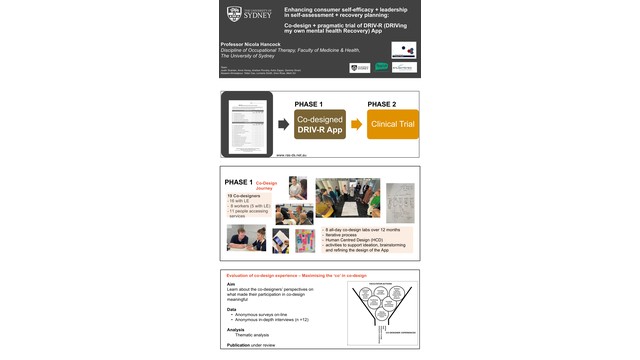
Introduction: Human rights-based policies and occupational therapy principles call for greater mental health consumer self-determination in health-related decision making and recovery planning. This project addressed previously identified barriers to translating this call into practice by co-designing a digital enhancement of Recovery Assessment Scale – Domains and Stages (RAS-DS) – an occupational therapy developed self-report measure of mental health recovery.
Objectives: To support more frequent collaborative planning discussions between clinicians and consumers, leading to greater consumer control and leadership over their assessment and recovery action planning.
Methods: This study involved 2 Phases.
• Phase 1: App co-design occurred through 10 co-design workshops. Data evaluating the co-design process were collected via survey and in-depth interviews and thematically analysed.
• Phase 2: A pragmatic, crossover trial of the App is underway. Effectiveness of the App is being measured by changes in mental health self-efficacy and mental health recovery following use of the App. Information on usefulness and acceptability is also being collected.
Results: Phase 1: An App addressing needs and priorities of co-designers was developed. Six features of the co-design process maximized co-design experiences.
Phase 2: Preliminary results will be presented. It is anticipated that measures of mental health self-efficacy and mental health recovery will show greater improvements when staff-consumer pairs use the App compared to using the paper-based version of RAS-DS only.
Conclusion: The DRIV-R App was co-designed by end users. Trial data will demonstrate whether the App is useful for enhancing mental health self-efficacy and mental health recovery through supporting collaborative planning and goal setting.