
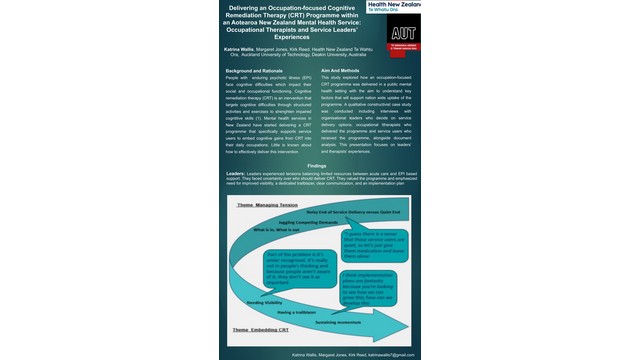
Introduction/Rationale: Enduring psychotic illnesses can lead to cognitive challenges, affecting a person’s day-to-day occupations. These challenges have not been well addressed within mental health services. Evidence shows CRT can address clients’ cognitive limitations, but little is known of how to deliver CRT incorporating an occupational focus to inspire change that improves people’s lives.
Objectives: The study aim was to gain understanding of the factors influencing the delivery of an occupation-focused CRT programme, to support an effective roll-out of the programme through Aotearoa New Zealand mental health services. Leaders’ and occupational therapists’ experiences of delivering the programme were gained.
Methods/Approach: A qualitative constructivist case study was undertaken within an organisation delivering the CRT programme. Managers and occupational therapists delivering the programme were interviewed and documents relevant to the case reviewed. Data was analysed using thematic analysis and direct interpretation.
Results/Practice implications: Findings highlighted complexities when delivering the programme. Leaders faced tensions when embedding CRT within services. Therapists navigated the fusion of occupation and CRT , with strong relationships and training pivotal to successful delivery. However, communication gaps hindered broader progress, other barriers identified, emphasising the need for leadership, training, and cultural responsiveness. Recommendations include broader health system direction and support, cultural consultation, and advocating for and ensuring an occupation-focused approach to CRT delivery.
Conclusion/Contribution to the occupational therapy profession: CRT programmes can be delivered with a focus on occupation highlighting future innovation in delivering the programme to benefit service users. With adequate training in CRT occupational therapists bridge the gap between a psychological intervention and apply it to people’s occupational needs.