
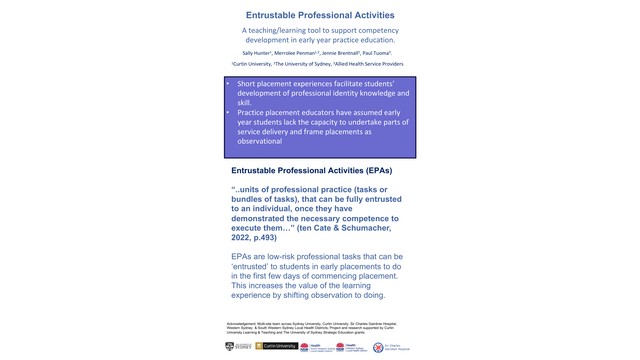
Introduction: Short placement experiences are commonly used early in occupational therapy courses to facilitate students’ development of professional identity, knowledge, and skill. However, with prioritising patient/client safety, practice placement educators have assumed that early-year students lack the capability to deliver services, framing the placement as primarily observational. To promote a shift in practice educator perspective of student’s capabilities, six Entrustable Professional Activities (EPAs) (teaching/learning tools) were co-created with clinical educators and implemented in early-year placements.
Objectives: The study aimed to explore whether the implementation of EPAs could support educators’ entrustment decision-making, enabling student learning and decreasing educator cognitive load.
Methods: This prospective qualitative study evaluated the effectiveness of EPAs through individual and small group interviews of occupational therapy educators (n=14) and students (n=8) who had experienced the use of EPAs in their short early-year clinical placements. Thematic analysis of audio-recordings was used to inductively analyse the data.
Results: Both educators and students benefited from the use of EPAs to support their learning. EPAs were found to assist educators to transition students from observational roles to confidently undertaking responsibility for low-risk clinical activities. Three themes related to student learning included (i)“Entrusted to Do”; (ii) “Being engaged”; (iii) “Facilitated accurate self and peer evaluation). In addition, a theme specific to educators was “Eased cognitive load of supervisors”.
Conclusion: The study findings indicate that the use of EPAs as a tool for learning assisted supervisors and students in making entrustment decisions. Overall, both supervisors and student’s perceptions of students’ competence was transformed.