
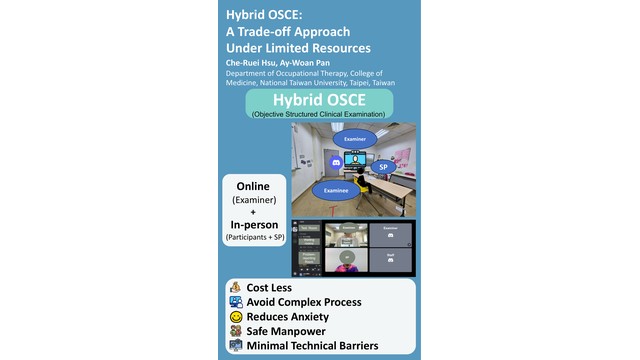
Introduction: Online OSCE(Objective Structured Clinical Examination) has proven effective for assessing clinical skills and can be an alternative to traditional in-person examinations. However, many institutions struggle with limited manpower and equipment, making a full online transition challenging without compromising fairness or effectiveness. An occupational therapy (OT) department at a northern Taiwan university also faces resource constraints that hinder a completely online OSCE setup.
Objectives: This study aimed to develop a Hybrid OSCE model that balances assessment effectiveness with resource limitations by integrating the strengths of both online and in-person formats.
Methods: All participants were junior students in the OT department. In our approach, examinees remained in three designated physical rooms and used personal devices to be tested on an 8-minute semi-structured interview via the Discord platform. The standard patient and examiner also participated online. Learning outcomes were evaluated using rating scale results— assessing evaluation abilities, communication, and interview skills, and qualitative feedback was collected from anonymous interviews with SPs, examiners, examinees, and staff.
Results: A total of 40 participants took part. Examinees in all three rooms met most criteria on the rating scales, with 58.9% rating their overall satisfaction as “satisfied” or higher, and 63.2% considering the exam’s difficulty appropriate. Although the Hybrid OSCE was appreciated for its convenience and flexibility, challenges such as unstable internet connections, insufficient on-site staffing, and long waiting times were reported.
Conclusion: The Hybrid OSCE model can reduce equipment needs while maintaining test effectiveness and satisfaction in OT educational settings. However, it may not achieve the expected manpower savings and requires additional resources to resolve connectivity issues. Future implementations should prioritize stable network infrastructure and adequate staffing.