
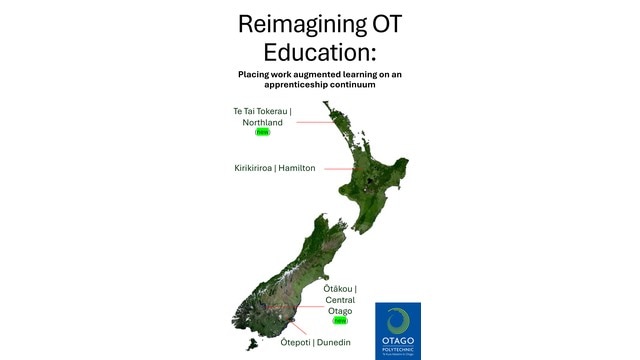
Introduction: Alternative models of delivering the Bachelor of Occupational Therapy (BOT) qualification are needed to address workforce shortages and enhance accessibility to degree-level education in rural and remote regions. In Aotearoa (known colonially as New Zealand), funding and systems do not promote apprenticeship delivery, shortages are so severe that traditional apprenticeships are not feasible, and there is opportunity to add value in communities that do cannot otherwise access occupational therapy.
Objective: This presentation will propose an apprenticeship continuum and position a newly developed work augmented learning (WAL) model of delivering the BOT in relation to traditional apprenticeships, work-integrated, and work-based learning style apprenticeships.
Approach: WAL is situated at one end of a proposed continuum of degree apprenticeships. The WAL model emphasises academic content contextualised by concurrent workplace experiences and distinguishes itself through its supervision model, tripartite agreement structure, and approach to workplace task integration and assessment.
Practice implications: This model allows for innovation to meet the unique needs of the health workforce in rural and remote locations. The proposed programme integrates workplace experiences, campus-based teaching, noho marae wānanga, teleconferences, self-directed study, and fieldwork.
Conclusion: By developing a WAL model of delivering the BOT , it is intended the programme will serve to enhance learner diversity, address workforce shortages, and contribute to eliminating inequities in education, economic, and health outcomes. WAL model seeks to maintain the benefits of workplace integration while adapting to the specific challenges and requirements of the occupational therapy profession in regions within Aotearoa that have limited professional resources.