
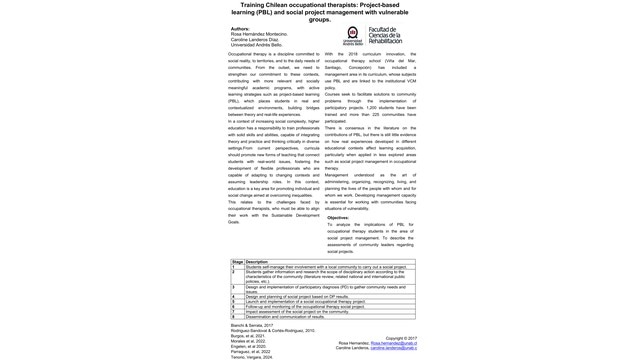
Introduction: Occupational therapy is a discipline committed to social and community problems. Occupational therapy students seek to facilitate solutions through the implementation of participatory projects since 2018 (1,200 students and more than 225 communities; elderly, disability, LGTBQ+, street situation, etc.), characterized by a participatory process of diagnosis, design, implementation, evaluation and dissemination of results. The teaching-learning process used is PBL because of the contributions it would develop, placing students in real and contextualized environments.
Objectives:
• To analyze the implications of PBA in occupational therapy students in the area of social project management.
• To describe the community referents’ appreciations regarding social projects.
Methods: Concurrent mixed methodological design, with a sample of 129 occupational therapy students from a private university and 13 community referents. The data collection strategies were: semantic differential scale and semi-structured interviews. The scale data were analyzed with Excel and JAMOVI, using the Kolmogorov-Smirnov test for large samples. The interviews were transcribed and analyzed using a thematic content approach. The study followed ethical principles of the Helsinki Treaty and Chilean Law 20120, applying informed consent.
Results: PBL enables the development of leadership, organization, communication, critical thinking, autonomy, creativity, resource management and networking skills. It favors motivated, committed, responsible and involved learning. Women value collaborative work and men value commitment to learning. It has contributed to social inclusion, health, wellbeing and has provided tools to generate economic resources and education in rights to the communities.
Conclusion: Students strengthen management skills from the PBA, execute innovative projects from the occupation that has strengthened communities and reduced inequalities.