
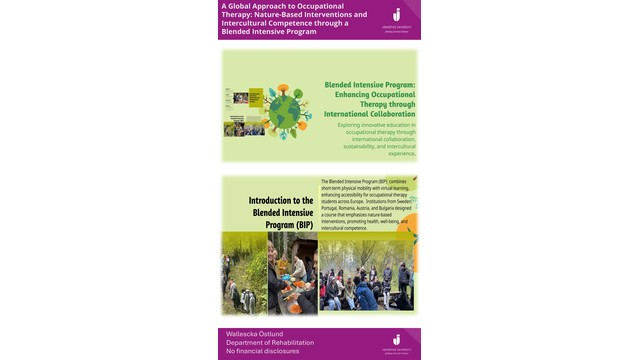
Introduction/Rationale: A Blended Intensive Program (BIP) promotes inclusion by facilitating shorter international student exchanges.
Objectives: Institutions from Sweden, Portugal, Romania, Austria, and Bulgaria collaborated to create a course on how nature-based interventions can support health, sustainability, and intercultural competence.
Methods/Approach: The course featured virtual components and one in-person component, incorporating lectures, international study groups, and site visits. Challenge-based and active learning strategies were applied as key educational methods. This program’s knowledge contributes to the design and selection of occupational therapy (OT) interventions from a global environmental perspective. During the in-person week, students participated in hands-on outdoor activities and designed nature-based OT sessions.
Results/Practice implications: Most participants found the course valuable for building global connections, and the students expressed high satisfaction with the course structure and activities. They felt that the balance between theoretical learning and practical application was effective. Both in Sweden and in Portugal, the outdoor activities were highly appreciated.
Conclusion/Contribution to the occupational therapy profession: While we shared core OT principles, each country’s cultural nuances enriched our practice. Collaborating with fellow students allowed us to discuss how OT techniques could be adapted in our countries, fostering a deeper appreciation for intercultural competence. The experience was overwhelmingly positive, and it was very interesting to realize the cultural differences regarding nature and nature-based interventions. To address regional differences, the course will rotate among participating countries, ensuring that its educational methods and outcomes are integrated into each university’s curriculum.