
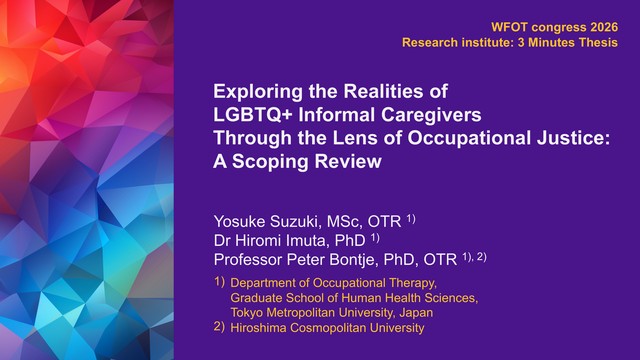
Objectives: LGBTQ+ informal caregivers face unique challenges shaped by societal discrimination and exclusion. Their caregiving experiences are influenced by their sexual orientation and gender identity, yet research on this population remains limited. This scoping review examines how LGBTQ+ caregivers’ experiences are studied and discussed through an occupational justice lens.
Methods: Following Arksey and O’Malley’s five-stage framework, a systematic search was conducted using the key terms “LGBT” and“informal caregiver” across four databases: PubMed, PsycINFO, Cochrane Library, and CINAHL. Studies published in English that explicitly discussed LGBTQ+ caregivers’ experiences within an occupational justice framework were included. Exclusion criteria comprised non-English studies, those not focusing on LGBTQ+ caregivers, and grey literature or non-peer-reviewed articles.
Impact/Results: LGBTQ+ informal caregivers experience distinct stressors, including the pressure of not being “out” in professional or community settings and tensions within their family of origin (Grossman et al., 2005; Hash, 2006). Accessing formal support services is another major concern due to fears of discrimination, service denial, and exclusion (Brotman et al., 2007; Croghan, Moone & Quam, 2012). These challenges contribute to significant psychological and emotional burdens, emphasising the need for inclusive and equitable caregiving policies (Metlife Mature Market Institute, 2010; Muraco & Fredriksen-Goldsen, 2014).
Conclusion/Contribution to the occupational therapy profession: LGBTQ+ informal caregivers navigate multiple marginalised identities, often rendering them invisible within both caregiving and LGBTQ+ communities. This invisibility leads to occupational injustice, as their unique challenges are frequently overlooked. Research remains scarce, particularly in Asian contexts. This review highlights these gaps and stresses the need for an occupational justice perspective to inform future research and policy development.